Translate

Monday, February 8, 2016

A Quiet Place.


When the chatter of the world gets too unbearable or the pressure on your shoulders threatens to break bones, you need a quiet place.  Sometimes it's just a few moments inside your own head, closed off from the world. It need not be far away or  particularly glamorous . . . which is something my father always knew.

Dad used to bring the Sunday newspaper and a cup of coffee into the garage. And he wouldn't emerge for at least an hour. With a household of eight, and a not-so-big house, I'm guessing that was the only way to get some peace without actually leaving the premises. And, like dad, we all need such a place, a quiet place  to . . .  let's say, regenerate.

Some high schools actually have what they call 'Quiet Time' as a means for decreasing anxiety and increasing confidence, which in turn boosts academic performance. And meditation, which for some might be in the form of prayer has lasting benefits, though I'm not sure I am yet able to quiet my brain quite that much . . . but perhaps with a bit of practice. In any event, it's worth a search to find that place and it need not be any more than a small corner and a simple few minutes ---  as dad always knew.


A not-so-small, kind-of-quiet place to think.


Saturday, January 30, 2016

A Solution to Greece's Problems

Greece has her problems but the biggest, in my opinion, is not her economy or unpredictable political climate. It's something that has existed throughout history and I have to admit, I often long for it.

Her problem is . . . air. Yes, that stuff that the Greeks inhale. If somehow they could've just stopped breathing it in, before they got into their latest crisis, I believe they'd have been more inclined to see through the insanity of borrowing money, decreasing their workload, and then spending said-borrowed money.

But that air! They were defenseless against it. It's just so subtle as it sweeps along on warm breezes, oh so sweet and anesthetizing. And in the summer months it picks up the sounds of cicadas--their songs carrying everywhere like the rhythmic rocking of a sailboat, slowly back and forth, until eyelids grow heavy and thoughts turn to mush.

Like white carbohydrates and refined sugar, my body longs for it in these work-day months as I recall its effect and reminisce of those lazy Greek summer days.

Well-rested from a good night's sleep, and ready to start the day, I've often left the front door of our Margariti house with a strong conviction to get something done and a rock-solid plan. But the minute that warm air pats the top of my head, my gait slows to a saunter and then the sunlight blinds my ambition.

That Greek air turns my limbs into iron girders, so naturally I have to rest from the weight of them. A cup of coffee might help because back in New York as I sip caffeine all day long like the drip of a life-saving intravenous, the work-gears continue to grind.

And yet, that same elixir--coffee--brewed with its turbo blast of caffeine there in Margariti, energizes me to the degree of which my only thoughts are in deciding under which tree I should position my chair so as to get the perfect mix of sun and shade.

So what are the Greeks supposed to do? Who could blame them for this new Greek mess? It's the creditors' fault. Had they spent only a few hours on the Greek countryside before doling out the money, they'd have seen the futility of it all.

This older generation was hopelessly weak from lack of food, years of poverty and terrible suffering, thus helpless against such an adversary. They sucked up that oxygen without a second thought and now it's up to the younger people to be strong -- to stop breathing that Greek air.

I wish them strength and I wish them luck!


Saturday, January 16, 2016

Food is Love

Julia Child said, "People who like to eat are the best people." Thank you, Julia.

Let's face it. Food is love and we all want to be loved. My mother-in-law, Chevi, used to cook for me. It was a great feeling. She'd tell me--not her son (He's one of those people who forgets to eat), what she was cooking that day and what time we should be home to eat it. And she and I didn't even speak the same language! It was done with gestures and pointing and a few words in Greek.

Those who are thinking about what they'll have for lunch as they read this, which in my opinion is completely normal, will understand what I mean about this whole food-love idea. Back in the 1970s when television had a few major stations and no remote control, I used to watch a show with my older brother, Jim. It was called The Galloping Gourmet. The host, Graham Kerr, would prepare a dish and then at the end, he'd pull someone from the audience to dine with him for the last few minutes of the program. Jim and I would run into the kitchen at every commercial break to prepare tuna salad sandwiches. The tuna had to be mashed with the mayonnaise and chopped onions into just the right consistency. And the bread popped into the toaster at exactly the moment when the last commercial break began. We would have our little snack trays set up in front of the sofa, so we could run to them with our sandwich plates and have the first bite of sandwich coincide with the first bite of the showcased dish on television.
I don't remember anyone else sitting there in the den as we bit into our sandwiches and voiced our satisfaction or complaint, if perhaps the onions hadn't been chopped finely enough. Our other siblings were probably outside running around with the neighborhood kids. I'm guessing they didn't find this activity quite as fascinating as did Jim and I.

I'm pretty sure my first words as a child were something like,"Where's the salt?" 


The first Greek words, however, that I attempted aloud, (besides the filthy stuff my husband taught me while we were dating) were also about food. It was to a group of Greek cooks in the restaurant where I worked in the early 1980s on Long Island. I had confused the words for plate and glass and asked for a glass of meat. The laughter that ensued resulted in a two-year-Greek silence, only practicing the language in my head until I attempted to communicate again, using my formal-book-taught-Greek in the rural village of Margariti. Another disaster--different story.

In those early Margariti days I was always anxious to get away from the village at the midday meal time. Each meal came with a multitude of guests. It could be very overwhelming at times. The food was placed "family-style" in the middle of the table and though I had grown up inside a family of eight--a perfect training ground for holding your own when the food is placed on the table--I was too shy to grab what I wanted and so that food-love was rarely satisfied. Only in later years when Chevi's children and grandchildren were far from the village, and my own had left me in an empty nest, did I fully realize the importance of the dining experience in Greece. It was partly a social gathering and partly a means for satiety. But mostly it was an act of love.

Chevi quietly observed me and eventually figured out what I was inclined to eat from that array of food. When she'd make certain dishes, she'd say to me, "for you." It was a very nice feeling. 
Chevi making cheese from goat's milk

Anastasia with pita
As a cook, Chevi was a perfect example of the older generation. Her baked dishes (butter beans, okra, stuffed tomatoes, eggplant . . . ) were swimming in olive oil. And incredibly tasty.

Eftihia making pita crust
She was also well-known for her pita. Pita means pie in Greek. She would roll the dough out to an almost translucent thinness and then stuff the pita with whatever fresh ingredient was available from the garden. Many times, the milk from her goats accompanied the other ingredients. I did my best to learn her cooking techniques but my results were nothing like hers or her daughters'.  


But Chevi understood the message of love delivered through these dishes. In fact, as my husband and I made our way to Greece a few summers ago, one of the last things she said before a major stroke took her, was: "I have to cook for my son . . . and for my nifi."


I'd love to hear from you!  authorfagiolikatsiotas@gmail.com

Saturday, January 9, 2016

The Rebel


Chevi was a criminal. There's no getting around it. As a middle-aged woman in the 1980s, she committed a criminal act, not just once but for several consecutive days and weeks.

This was very uncharacteristic of her law-abiding, sweet nature so it's sometimes hard to believe it actually happened. It's true, though. Her grandmother had told her a story once that Chevi repeated often to us and it was that story that governed her actions during her crime spree back in the 1980s. Because Chevi's mother had died shortly after childbirth, it was her grandmother who raised her and who taught her the appropriate behavior for living life in their isolated mountain village on the Greek countryside.

Her grandmother's story went like this:   There once was a little girl who did not have enough to eat. She was starving but she was also too shy to ask for food. When people offered her food, she said no, because she felt it would be rude to accept, knowing that it was most likely not even enough food with which to feed that person who was offering. And so the little girl died of starvation.

True story? It doesn't matter. It governed Chevi's actions for the rest of her life and it personifies the cultural norm surrounding the Greeks' insistence that you accept their food. 


Don't ask the person if he wants food or drink. Give it to him and insist he take it.

So in the 1980s, when the government of Albania collapsed, and the Greek government relaxed the guard at the Albanian borders, just north of Margariti, a flood of illegal immigrants came over the mountains and passed through the valley on their way south in pursuit of a better life. I don't know the political aspect of this situation and neither did Chevi.

But one day Chevi went to tend to her animals on the farm and she saw some young boys eating the stale bread she had left in the dog’s bowl. When she spoke to them in the local Albanian-like dialect, they understood her. She gave them food and water and then they continued on their way. Somehow these moving bands of young Albanians heard about this kind woman on the farm in Margariti and there were always more boys to feed each day.

One particularly skinny 15-year-old, stayed on the farm with her for a while. Perhaps he was worn out from the journey over the Pindos Mountains, or maybe he just saw Chevi as a surrogate mother and didn't want to leave her. But he stayed down on the farm in the goat shed and she gave him fresh food every morning.

Then one day someone reported him to the police. It’s likely that others had seen him prior to that day and had stayed silent. In those days there wasn't much vegetation in the valley or on the mountainside so people could easily see from the top of the surrounding mountains down into the valley of the farmland.


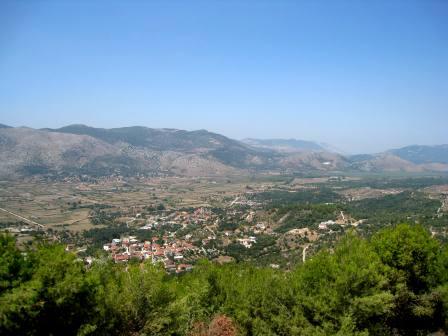
The picture on the right shows how barren the landscape was back then.

This flood of young immigrants also came with the characteristic racism that usually accompanies them, so maybe someone reported him because, instead of a small 15-year-old boy, hungry and alone, they saw an Albanian, or a criminal. In any event, the police came to get him. But before they could, Chevi was alerted by someone in town which gave her a few minutes to guide the boy from her farm to her house.

Across the front yard was the beginning of construction that would someday be the home Nick and I would live in, and there was one piece of cement that sat atop the walls for a hallway ceiling, so the boy climbed up there and hid. The police searched the farm and found nothing so they came to the house and questioned Chevi. She wasn't fond of lying but she had no second thoughts about it in this case. This continued for many days, until the police assumed the boy had left Margariti.  


Each morning, before she lit the cooking fire or began her chores, Chevi would call the boy down from the cement slab when she thought no one would see, and she'd give him a meal inside her house, usually pita that she'd made the day before. Then the boy would climb back up into his hiding spot so as not to be seen by the numerous visitors who came unannounced at various intervals of the morning, hoping to get a piece of Chevi's fresh pita as she began her daily cooking. There was always that one small pita, that she'd hide from her guests. 

That skinny little boy is now a legal Margariti citizen, a grown man with a wife and children. He was a frequent visitor of Chevi's while she was alive and if she needed anything, he was quick to help her.

Chevi was a remarkable woman. She'd witnessed atrocities during World War II and the civil war that followed. Over the years she'd experienced the tumultuous changes that came with different ruling parties and different governments. But she, herself, was always governed by the simple laws of morality.

The greatest crime, she thought, was in withholding food and water from a hungry person.


Independent authors often have quite a challenge in getting exposure for their work. I hope, dear reader, you will consider writing a review on Amazon or Goodreads.com. 


Wednesday, December 30, 2015

Making Promises


There once was a woman who didn't know how to drive a car. She promised herself every January—with a list of other promises—that she'd finally learn to drive. But it seemed too complicated, all those gadgets and buttons and well, her husband, Bert, had always done that sort of thing. But when at the age of 75, she watched poor old Bert reach for his jacket in the back seat of their beat-up old sedan and slump lifelessly to the floor, she realized her time to learn to drive had arrived. First she dialed 911 and received a recorded message, then she screamed for her neighbor who appeared to not be home. Then she pushed poor old Bert further into the back seat, closed the door, got into the driver's side and backed the car out of the driveway with all the speed and prowess of Mario Andretti.


The hospital was only 3 blocks away so she didn't have much time to think about the fact that she was, for the first time in her life, in the driver's seat.

But when she did have time to reflect on it (and after she found out that poor old Bert was okay), she felt very proud and happy. And then she felt very sad.

"But why, granny?" her awestruck teenaged granddaughter asked, "Why are you sad? You should be proud!"

"My dear," Granny looked at her with solemn eyes, "it's an awful feeling, at my age, to realize you can do something you thought you couldn't." She shook her head slowly. "And worse than that, is wondering about all those other things you hadn't tried because you thought you couldn't."

Granny has a good point, doesn't she? Forget about January promises. Let's just go out there and do the things we still have time to do!


I'd love to hear from you! authorfagiolikatsiotas@gmail.com

Sunday, December 6, 2015

From the Big Apple to a Big Greek Village


An interview by author Marjory McGinn from her blog Big Fat Greek Odyssey 


Caption for linda and hubby with NY skyline
A recent photo of Linda and Nick in front of the New York skyline
This week I am interviewing Linda Fagioli-Katsiotas, a New York teacher and writer who married a Greek in the 1980s and bravely went to live with her new family in a remote and raw village in Epirus, in Greece. Her fascinating story is the subject of her memoir The Nifi.
Q: Welcome to my blog, Linda. Tell us a bit about yourself.
A: First let me thank you for inviting me to this interview. I was born and raised on Long Island, outside of New York City. My father’s parents were Italian immigrants and my mother was from the little town of Malone, in the Adirondack Mountains; her parents were French Canadian. I’ve been a teacher for 21 years, working with immigrant children at my local school.
Q:  In your 20s you married a Greek. Tell us a little about that.
A: I met my husband in 1980 at a restaurant on Long Island, where we worked together. Nick had been in the US since 1978 and didn’t speak a lot of English but it was enough. Later we eloped after knowing each other for about a year. It was a marriage with all the trimmings for failure: different culture, religion, language, ethnic background, but somehow we made it.
margariti village caption
The traditional village of Margariti in Epirus
nick and linda cooking goat 1983
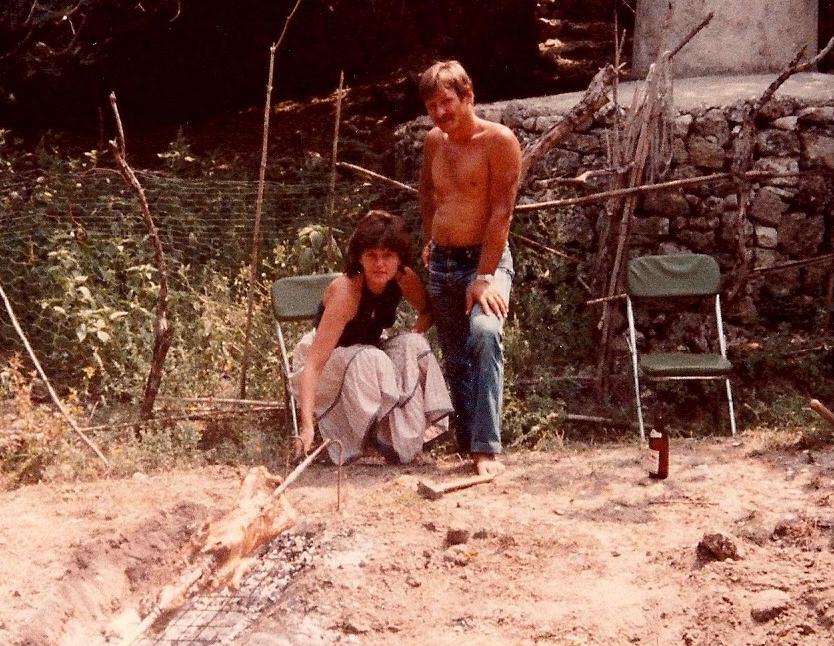
A young Linda and Nick in 1983 getting to grips with village life, and roasting a goat for lunch
Q: Later you went to live for a while in your husband’s native village of Margariti, in Epirus, north-west Greece. What was your Big Fat Greek Immersion like?
A: At that age, I had no idea what I was doing. I was madly in love and, probably like every young person then, I wanted a life that was different from the mainstream. Nick was quite a tough person and I realised when I got to his village why he was like that. Most of the people in Margariti are tough. It’s a matter of survival. The journey to his village was my first trip out of the US.  Epirus is a beautiful mountainous area with some of the most exquisite beaches as well like Karovostasi. But lovely surroundings quickly lose their appeal when you’re living in quite primitive conditions, without the ability to communicate with anyone.

Sunday, November 8, 2015

Mourning Trees

How we treat nature, speaks volumes about who we are. When we see the majestic branches of trees that are intertwined with age and wisdom, what do we actually see? Something to: water, climb, hug, prune, or just grab a chainsaw and cut down to nothing?

To some, this beautiful mass of greenery below is a work of art . . .


. . . and yet to others, it's a mess of gnarled obstacles that needs to be eliminated.


That green wall of vegetation stood tall behind our fence one early June morning when I left my house, but it was completely gone in the afternoon when I returned. Beside my own loss, I was struck by the confusion of the wildlife that, for hours and days afterwards, searched for their homes. Birds with worms in their mouths circled the naked area looking for their nests, and squirrels ran about without direction. Their world had vanished without explanation, gone because of one human being, greater than they, who had ownership of, and the means to destroy, a hundred years of growth.

I mourned those trees for a long time after they were gone, each day as I looked out my windows and saw my neighbor's house. Not because of privacy but because I'd watched them grow for almost sixty years. Among their branches were the threads of my childhood, my adolescence, the birth of my children and the struggle of growth that ensued year after year.

I'm really a bit baffled by this new . . . let's call it "change."  Was it my neighbor's desire for clean straight lines and a well organized space? A sort of comment on his frustration at how unpredictable and random nature can be and therefore, a need to tame it in hopes of neat, tightly kept spaces to live life?


For a few weeks I lived in a cave with my shades drawn. It wasn't that people could see in, but rather I couldn't bare to look out. And then slowly I got used to the idea. I accepted the change. The old replaced by the new.

And not long after, there was a similar "change" happening across the ocean, back in Margariti. An old olive tree, unyielding and set in its ways, was cut down and dug out, leaving a tiny orange tree that had struggled beneath its oppressive shadow.

And on the farm, a group of adolescent maple trees was transplanted from where they'd fallen as seeds at the base of a deep ditch.


They were brought up onto flat land, planted side by side within the valley where direct sunlight now hits their branches and the drapery of mountains has become their backdrop for the future, replacing the shady mud of the ditch where they'd struggled to grow for several years. Some are slowly dying and some are fighting to live but it is a certainty that none would have survived much longer in the ditch.


Different location. Different rationale.


I'd love to hear from you!

authorfagiolikatsiotas@gmail.com


Sunday, October 18, 2015

Rules for living in Greece

Are you a rule follower?

Katherine Hepburn said: "If you obey all the rules, you miss all the fun," and Socrates: "Sometimes you put walls up not to keep people out, but to see who cares enough to break them down."

So rules are made to be broken, right?

Good Lord, I have no idea!
I just know that I'm always the anxious person behind the rule-breakers whispering, "Are you sure this is okay?" while biting my nails and looking over my shoulder. Which describes many of my outings in Epirus.

Below is a sign explaining the funding of six hundred thousand euros from the EU to the Greek government to keep an archeology site open. This one happens to be the ruins of an ancient city overlooking the Preveza bay.

But it appears that the money was used for a chain and lock.


So, when we arrived there after a pleasant walk through the woods, we were disappointed but not surprised, as these are hard times in Greece so for whatever reason, we've accepted closed locations that had formerly been open.

On the other side of the gate, within the archeological site we spied some movement and then a man slowly came forward with the unsure stride of a trespasser. 

"This is not a Greek person," Nick said, and Cousin Errieta who had accompanied us on our outing, agreed. They were both right. The non-Greek speaker hesitantly motioned to the fence a few feet away from the gate, until we realized what he was showing us.

Apparently, he also had wanted to see the archeological site and at first we thought it was he who had cut the hole in the wire fence, which he was directing us toward. It seemed a drastic measure because archeological sites are everywhere in this country--in household gardens, on the side of highways, next to supermarket parking lots--so why not just find another one. But perhaps this ancient city was one spectacular enough to take the time to buy wire cutters, climb up into the rocky buttress along the gate, and make an illegal entry.

Wednesday, August 5, 2015

Is That an Airplane I Hear?

“What’s that noise!?” 

Are you the kind of person who hears the high-pitched whistle of an approaching airplane as you lie in bed at night and wait for it to pass—grateful that it’s passed you by and is still airborne?  In my family that’s totally normal. We Fagiolis are hypersensitive to sound. I suspect, if we were wired to lab equipment when we hear a “ping” or bump that isn’t familiar to our super-power ears, there would be evidence of dilated pupils, a racing heart, increased breathing—again, all normal—genetically acquired.  (This hypersensitivity to sound does not include people speaking.)

Recently, Nick had the opportunity to fly in a two-seater airplane. He flew over the Margariti valley and along the Ionian coastline in a seat beside the pilot, a local man named Athanasios Giannelos. Athanasios highlights many of his flights by using a camera attached to the plane and posting the images to his Facebook page, AIRFIELD MARGARITI.

Originally, Nick thought that I might want to fly with Athanasios, but given the fact that a flight in a jumbo jet brings me to my knees,  I decided to pass. Maybe another time. I knew, however, that Athanasios and Nick would be flying over the house so with much excitement, I awaited the sound of the plane engine as I tried to go about my business. I even changed into a red blouse so that they'd be able to spot me on the balcony.

What actually happened was this: 

Tuesday, July 21, 2015

A Tale of Two Packages

“Only a masochist with deep pockets would want to pursue [it].” That phrase is from author, Marjory McGinn, describing her registering of her car legally in Greece, the operative word being legally. That was after the villagers tried to persuade her to do it . . . let's just say, a more successful way. I’ve been thinking of that lately as I await a package that I regret ordering online and having sent to me here, in Margariti.

I love Greece, Epirus in particular. And I accept the fact that “business” is run a bit differently than in other parts of the world but I’m not here on business, so that's fine with me. That being said, when I ordered something from Amazon.com and had it delivered to the Margariti address, I did it, more or less as an experiment – sort of like tying a message to a balloon and seeing if anyone ever gets it.

I expected nothing but hoped for the best. And I was pleasantly surprised when, two weeks later, I got a text from Amazon saying the package had been delivered. So Nick went to get it from the post office but the postmaster said he hadn’t gotten anything for us even though the tracking number showed that it had been delivered—but it had not.

Okay,” I thought. “I tried.” And with all the optimism of a person on vacation, far from the stress of work or bill-paying, I cheerfully continued to hope for its arrival. At some point, I called a representative at Amazon.com which resulted in a full refund and the representative saying that if the package did eventually show up, it was still no charge.

Friday, July 10, 2015

Greece's Doctors

I recently had an unusual encounter with a doctor. It was quite different from my first visit to a physician's office in Greece back in 1983--for a severe case of food poisoning. The doctor back then also had his office in the port of Igoumenitsa, but to get there, we needed to take a bus from Margariti on a narrow winding road around several mountains--not a very pleasant trip even in the best of health.

As I recall that day, I remember the doctor well. His office was small and unremarkable. He spoke perfect English and he attended to me with great care and kindness. The medication he prescribed was very effective. Overall, it was quite a reassuring experience, as I'd been staying in the somewhat primitive conditions in which Margariti was engulfed at that time.

Over the years, there have been other doctor visits: dentists, pediatricians, general practitioners. All providing very good care for a small affordable fee.

This most recent visit however, felt a little different. I needed to see a dermatologist. One was recommended by someone in the village. So we drove the  17 miles to Igoumenitsa, about a 20 minute drive with the new smooth and modern Egnatia Highway. Once there, it took us a while to find the doctor's office because it was located away from the center of town, in a residential area. The sign to the office was small and somewhat hidden by vegetation. The office itself was on the first floor of a residential building which was reached by walking through a gate into a beautifully manicured yard. It was shared with a dentist as indicated by another sign and it appeared to have a home on the upper floors. This is not terribly unusual in Greece but it's the first time I, personally, have seen a doctor who is outside of the business center of Igoumenitsa.

The unusual part came when the young doctor opened the door to the waiting room to usher us into his inner office.

Monday, July 6, 2015

A Warm Traditional Zagorian Home


When I read his book, The Ionian Islands and Epirus: A Cultural History, Jim Potts' description of Zagori, an area in the Epirus region of Greece, was somewhat familiar to me as I'd been there several times. However, I never expected to be as fortunate as I was recently when Nick and I were invited to Zagori's village of Vitsa to spend time with authors Jim Potts and Maria Strani-Potts. Entering their restored Zagorian home was like passing through the doors of time, into another world and era.

Though the materials used for the restoration of the old house were new, the design remained true to that area's ageless architecture which makes use of the most abundant construction materials of those mountains: a variety of stone and wood.

The original front gate has the charm of its weathered wood. That gate leads into a courtyard that is partly covered by an upstairs room of the house. It is adorned with wall coverings taken from the sides of an old cart, while a metal milk container is fashioned into the pedestal of a small table which sits between two comfortable-looking chairs, making a very inviting sitting area, so inviting in fact, that a small bat has taken up residence inside a small blue light on the ceiling.


A working cistern also sits in that covered part of the courtyard and Jim told us that it was used at times when the restoration rendered the indoor plumbing unusable.

From there, the courtyard opened up as we walked through a lovely archway into an open space with trees and flowers. The front door of the home sits unassumingly in that bright courtyard and walking past the strings of beads that hang in the doorway, we were led into an adorable well-stocked kitchen from which Maria and her friend, Fantina prepared us a wonderful local feast.


Off the kitchen is a narrow winding staircase that leads to the second  floor where the main sitting room is full of fun artifacts from the couple's life in different countries.

Friday, July 3, 2015

The Economic Crisis in Epirus

Days before I boarded my flight to Greece, I'd heard that the economic crisis was heading toward a critical turning point. I worried about civil unrest, the banks running out of money or not being able to use my ATM card. . . but of course, not enough to cancel my trip.
On the last leg of the journey, I traveled aboard a somewhat empty ferry from Corfu. While sitting inside the lounge, I  watched the panic unfold on the television, not quite sure what the Greek newscasters were saying and when I finally disembarked in Igoumenitsa, the chatter of English-speaking tourists deepened my concern.

I cannot tell you what is happening in the cities nor can I tell you about Greece's islands or all of her countryside villages. I can only tell you what I see and hear on the Northern coastline of Epirus.

The banks are closed. They've been closed for the past five days. Small business owners are unable to get the supplies they need to conduct business because there is no way to pay a supplier electronically, so businesses sit idle and orders go unfilled. The ATM in Amoudia was filled the day before yesterday, so said one fisherman as we relayed to him that it is now empty. In the supermarket in Kanalaki, the flour and rice shelves are empty, though there seems to be plenty of other products. The ATM there has money but only $60 per day per card. If I were a younger person with a family, I would be taking that $60 and stocking up on canned goods. The roads have very little traffic on them. There seem to be more motorbikes than cars. At $60 a day, it's probably foolish to waste money on gasoline for a car. There are far fewer tourist than in years past. In fact, some of the seaside towns such as Plateria, and Amoudia, towns that are mostly visited by Greeks on day trips, are so deserted that they remind me of a time long ago before the Egnatia Highway and the influx of easy travel. It's a circumstance that I have often pined for with the new era of crowds and summer commotion, but now that the empty beaches and empty eating places are back, I can't say that I am glad about it. As the saying goes: Be careful what you wish for; you just might get it. 

I have to admit, I'm feeling a bit uneasy.

Best Bookstore in Greece!


This adorable little bookstore in Parga, Greece, has increased in size with each year that has passed. They've also added books written in languages other than Greek. This year they added THE NIFI to their English-language collection and I am so incredibly amazed that they've sold out! A new order is on the way, but if you bought one from this bookstore I'd like to say a big THANK YOU! and I hope you enjoyed it.

If you're still in Parga and looking for another book to read, I'd like to humbly suggest YOUR OWN KIND, which I hand delivered to them yesterday.

Happy reading!

I'd love to hear from you! authorfagiolikatsiotas@gmail.com 

Sunday, June 7, 2015

A Summer Body


I've just gotten one of those catalogues from Victoria's Secret, the one that has me absently looking at my profile in window reflections, as the summer approaches. But the true Secret here, is in the speed with which I'm able to get Victoria to the trash upon her arrival to my home, rather than having her sit on the counter, staring at me for a few hours or days.

When I first started working with adults with brain injury (mostly strokes), they all looked quite old to me, but over the past few years, they've somehow gotten younger and lately those I'm giving therapy to, are around my own age.