Translate

Sunday, April 3, 2016

Author Interview by Janet Emson


It was an honor to be featured on Janet Emson's renown book blog, From First Page To Last. A copy of the interview is below but the blog itself has many author interviews and book reviews for the book lovers among us!

You can check out the blog  HERE

Today I’m pleased to welcome Linda Fagioli-Katsiotas author of The Nifi, a memoir which inspired Linda’s blog and Your Own Kind, a fiction novel. Linda kindly answered a few of my questions.
1. Tell us a little about Your Own Kind.
It is 1974. Alexandros is a young man who has left his rural Greek village to come to New York to work in his cousin’s restaurant. The restaurant is in East End, a small seaside village fifty miles from New York City—not exactly what Alexandros had expected when he heard he’d be going to New York. Sarah is from a small town in the mountains of New York State. She has moved to East End to escape the sins of her past. Of course, they fall in love—no surprise to the readers. But a difference in culture and tradition stands in their way, as Alexandros is betrothed to a girl back home and Sarah has a secret that would deter Alexandros regardless of the situation. Add to that, one son of Turkish immigrants—a love-sick adolescent, whose jealousy, thirst for revenge and misinterpretation of events set in motion a series of actions that lead to violence and heartbreak.  Maybe life would be easier if people would just stick with their own kind. But what does that actually mean? This book explores that theory.
2. What inspired the book?
I married my Greek immigrant husband in the early 1980s. We eloped because it was frowned upon on both sides of the family, regardless of the fact that we were so in love and so compatible.

Saturday, April 2, 2016

Learning to Speak Greek

"I want to ask you a question."

That was the simple message I had intended as I struggled to communicate in my newly-learned-broken Greek, with my brother-in-law. I was alone with my children in Greece--and by alone, I mean without any English-speakers. I knew by his facial expression, that whatever it was I had said to him, was not what I had intended. I waited patiently for my husband to arrive a month later so he could translate. I found out that I had actually told my brother-in-law I wanted to make love. The two words are similar.

By the same token, a few years later, my brother-in-law struggled to use the English he had learned. I was holding his infant son and my guess is that he wanted to say, "the baby loves you." What he actually said was, "I love you, baby."

Language is so integral to who we are and when one is surrounded by the incomprehensibility of an unknown language it can be a very frustrating situation.

My attempts at learning the Greek language have been many, the first of which was back in the early 1980s after having fallen in love with my husband, Nick, who was a Greek immigrant in the kitchen of a diner. At the time, I was enrolled in a college computer class trying to learn the language of computers which turned out to be far more illusive than the Greek language--for me, anyway. Rather than attending to the nuances of Cobalt Computer language, I sat in class writing and rewriting the Greek alphabet. Now, if my handsome Greek cook had spoken Cobalt, I might have become a computer programmer, but alas, that whole college stint didn't work out very well, but that's a different story entirely.

Fast forward to the newlywed couple about to embark on a trip to Nick's village of Margariti, in rural Epirus Greece, 1983. I'd bought a book in Queens, New York called Greek Made Easy. Even as I write this, the title makes me laugh. I'd studied it faithfully, hours a day, to prepare for my trip but once there, no one understood a word I was saying, or trying to say. A book entitled, Greek Village Language would have been much more useful.

Fast forward another ten years as I acquire my position in the local school district, teaching children who do not speak English. It's a very rewarding and sometimes comical job. Some examples of the questions students have asked me are:

1. Why do people always say "cheeses" when they are upset? The student was actually trying to interpret the exclamation "Jesus!"

2. What does "speechy" mean? This one was a little harder for me. I asked the student in what context he'd heard it. His answer: "I said to someone, 'how are you?' and she said, 'just speechy.'"  Interpretation: Just  peachy.

Friday, April 1, 2016

A Little Village

My mother is from a place called Malone. It's a small village, or so it seemed to us Long Island kids when we spent summers there, just along the Adirondack Mountains near the Canadian border. To us it was a quaint little place with a main street, fair grounds and a recreational park where a small river was cordoned off for swimming. I remember it fondly, but to mom it was a place from which she needed to escape, so in the early 1950s she made a journey to New York City to live with her sister. That's where she met the I-talian, as Grandpa Omer used to call my dad--the foreigner. Though dad was born in the Bronx, I suppose that was like a foreign country to my Adirondack grandparents. I wonder what Grandpa Omer would have thought of my Greek husband, had he lived long enough to meet him.

My mother's mother, Grandma Anne, came from a tiny speck of a village called Owl's Head. She resented having to keep house after her father died in a logging accident and her mother had to run the general store. She married Grandpa Omer to get away from her little village and to live in a large town like Malone, as she put it.

My Italian grandmother, Nanny Giovanna, and her husband, Chelso who died long before I was born, came from two small villages whose names escape me. Nanny always identified them as being near the Italian city of Piacenza. She came through Ellis Island to the U.S. in the early 1900s, and according to her, the one and only reason she left was so that she wouldn't have to work on the farm. She always said that she never regretted leaving. Village life was just not for her. She met her husband in the Bronx and yes, life there was quite a distance from the family farm on the Italian countryside.

And yet, here I am living my entire life in a never-ending sprawl of suburbia outside of New York City--always longing to be part of a village. The irony is palpable.

The first time I saw my husband's small village of Margariti, in Epirus Greece, if we can ignore the mind-numbing culture shock, I do believe I fell in love at first sight . . . or maybe second.  I was especially  attracted to the closeness of the people and their symbiotic lifestyle.

So maybe my ancestors put forth great effort to remove the little villages from their past, in the belief that they were creating a better life for their descendant in the future. But I'm pretty sure the little-village-gene got passed down and their good intentions were overthrown by nature.

Tuesday, March 22, 2016

Searching for Your Roots

There seems to be a natural pull from the past for people to seek out information about their ancestors. I'd venture to say this is the reason for so many websites: ancestry.com, geneology.com, my heritage.com . . . They go on and on. For us Americans our heritage usually lies in another country, unless of course, you are a descendent of a Native American. This may be the reason I was so attracted to my Greek husband in the first place. His foreign status reminded me of my Italian heritage that had been washed clean in an American suburb. The Greekness was so concrete and defined and familiar . . . but it was his, not mine.

I wanted it.

There's nothing worse than a convert, right? And I think I've proven that. Once I securely harnessed the wild Greek with a marriage license, I dove head first into the Greek culture, dragging my Italian extended family with me. (Nick's family were all in Greece.) And I was so successful that my nephew, Steven, with my Italian brother as his father and a mother who came from the nicest Long Island Brooklyn-Italian stock, came home from kindergarten one day with a heritage project sporting a large Greek flag. My brother, Jim, had a talk with him but I'm not sure Steven accepted it completely. Twenty years later he went to Greece for his honeymoon. . . I'm just sayin'

Cousin Dina, Tom, Nikki and Cousin Marianna
But this seems to be true for others as well. In my visits to Margariti, Greece, I've come across many Brits and Australians looking for evidence of their past. Some are former vacationers who had a memorable summer in their youth with a local Greek while others are themselves Greeks--children or grandchildren looking for evidence of their past. One in particular stands out in my mind. She was a young woman from Australia. She'd come to find her heritage and I was there alone with my kids that year. It was a very difficult situation for us both and when we found each other it was like finding water in a desert.

Sunday, March 6, 2016

The Face of Courage


Chevi & daughter, Anastasia
Imagine you are a young child running for your life, from an enemy of whom you’re certain wants you dead or enslaved. You’re being guided by the one person you trust the most: your mother. And yet at the very moment that you feel freedom is but a breath away, you are sent to your death by that trusted person. 

This is the story of Anastasia Lykas from the villages of Souli, in Epirus Greece. She was my mother-in-law, Chevi’s, great grandmother and her spirit remains in one of Chevi's daughters, a namesake—Anastasia, a woman of strength and determination.


Near the village of Zalongo atop the majestic cliffs that overlook the Preveza Bay and its lush green valley, stands a monument to those brave women who fled their enemy in 1803 during the Souliotes  War. One of them was twelve-year-old Anastasia Lykas. The monument is barely visible from the main road, but it remains an important tribute to the memory of those women, forced to make an unforgivable choice so their children would not experience an even greater horror.


Saturday, March 5, 2016

You're not Greek unless. . .

To be truly Greek is to be baptized in the Greek Orthodox Church. The number of times a person attends church afterwards is not relevant nor is that person's lifestyle. Simply, you must have been baptized in the Orthodox Church to make the claim.

I did not make that plunge until Nick and I were twenty years into our marriage. I had taught Sunday school at the Orthodox Church and dragged my kids every week to those services and to church celebrations while Nick worked. In fact, Nick was there so rarely that at one church-filled Easter service Father John jokingly looked at him standing under a gargantuan chandelier and made a hand movement for him to move aside, first looking up at the light fixture and then at Nick, as if to say, just incase God enjoys irony.


Years before, however, as a young mother, having married outside my own faith and feeling the strain of being an outsider, I agreed to have our children undergo this major Greek blessing.

Nikki was baptized by Father John in St. John's Greek Orthodox Church on Long Island at the oblivious age of six weeks, as was common among my side of the family, the Catholics. However, Thomas was baptized by Father Basil from Senitsa. The ceremony took place in the Margariti church in Greece and at two and a half years old, Thomas was old enough to protest and call out to us while Nikki tried to execute an escape.  

Here is an excerpt from  the memoir, The Nifi:

     I helped Akis gently lift my son from his mangled clothing. Thomas liked his adolescent Godfather very much, as he was someone who always seemed to have time for fun, but that unwelcome new activity was now creating a scowl of distrust on Thomas' face. 
     "No! Go out." His little finger pointed to the church door, but he was quickly whisked away and was being carried up to the caldron of holy water near the altar, his cries escalating.
     "Mommy!"
     I kept one hand on his warm back as I tried to keep pace with the others. 
     "I'm here honey. . . I'm here."
    "Hey, what are you doing to my brother!?" Nikki grabbed at the robes of the priest as he took the screaming little boy in his arms. She was readying to execute some kind of rescue as she pulled back her leg for a kick and I wondered at the wisdom of subjecting small children to such a ritual. 
     The relatives stood about with big smiles, talking and pointing at Nikki as she continued her efforts.


Wednesday, March 2, 2016

A Bed in the Yard

Without a doubt, the weather of Greece invites an outdoor lifestyle and with it comes the need for outdoor furniture. In the U.S. lawn furniture can be as fancy as a cushioned couch or as cheap as a metal put-together-with-spit-and-glue chair. In Epirus, Greece, those white plastic chairs that the gypsies sell off the back of trucks, are most likely what sit on balconies and in yards. However, before the 1990s, an overturned wooden box or the steps of a house, were a perfectly good place to sit.
And for siesta, there was always a bed out in the yard. Every house had one. I remember the peculiarity of it when I first came in 1983. But then those beds faded into the familiar background as the years progressed, until they slowly ceased to exist. This photo shows Cousin Evangelini at her house in 1988 preparing for siesta.

A bed outdoors had the same function as an outdoor lounge chair but really more practical when you think about it because it could be used inside or outside. In those days, there was no money to waste on something that would have a limited function -- like outdoor furniture, at least not until the EU money started to flow. And ione wanted to sit outside, rather than recline, a wooden or metal chair could easily be dragged from the house.

It wasn't until many years later that plactic products emerged with a vengeance. In fact, I helped to increase the barely-existent Epirote global footprint by bring plastic ziploc bags and plastic tupperware containers because I was not satisfied with the cloth that was laid over the food as protection from flies or the leftovers in the refrigerator, uncovered. Alas, I hold my head in shame.

After the two o clock meal, shops closed for the four hour “siesta.” And all movement stopped – even the animals slept. There was neither a bark nor a tweet (only a few light snores emerging from those beds) and it was a silence I've not heard since.  At first, it seemed odd to give so much time to the day for something as useless as sleep, but then as time went on, I could feel my eyelids grow heavy as I ate the afternoon meal and it just seemed natural.


My daughter, Nikki, however, wasn't having it. She never did see the point. On the other hand, Thomas, my son, was a true sleeper so he was completely on board with it all, no matter where we happened to be at the time. I also embraced it, though I usually slept less than an hour. But I would wake up so refreshed and ready to start anew.


There is something about having everyone around you just stop and regenerate. I long for those siestas when I'm away from Margariti. There is wisdom in such a custom. 


Monday, February 8, 2016

A Quiet Place.


When the chatter of the world gets too unbearable or the pressure on your shoulders threatens to break bones, you need a quiet place.  Sometimes it's just a few moments inside your own head, closed off from the world. It need not be far away or  particularly glamorous . . . which is something my father always knew.

Dad used to bring the Sunday newspaper and a cup of coffee into the garage. And he wouldn't emerge for at least an hour. With a household of eight, and a not-so-big house, I'm guessing that was the only way to get some peace without actually leaving the premises. And, like dad, we all need such a place, a quiet place  to . . .  let's say, regenerate.

Some high schools actually have what they call 'Quiet Time' as a means for decreasing anxiety and increasing confidence, which in turn boosts academic performance. And meditation, which for some might be in the form of prayer has lasting benefits, though I'm not sure I am yet able to quiet my brain quite that much . . . but perhaps with a bit of practice. In any event, it's worth a search to find that place and it need not be any more than a small corner and a simple few minutes ---  as dad always knew.


A not-so-small, kind-of-quiet place to think.


Saturday, January 30, 2016

A Solution to Greece's Problems

Greece has her problems but the biggest, in my opinion, is not her economy or unpredictable political climate. It's something that has existed throughout history and I have to admit, I often long for it.

Her problem is . . . air. Yes, that stuff that the Greeks inhale. If somehow they could've just stopped breathing it in, before they got into their latest crisis, I believe they'd have been more inclined to see through the insanity of borrowing money, decreasing their workload, and then spending said-borrowed money.

But that air! They were defenseless against it. It's just so subtle as it sweeps along on warm breezes, oh so sweet and anesthetizing. And in the summer months it picks up the sounds of cicadas--their songs carrying everywhere like the rhythmic rocking of a sailboat, slowly back and forth, until eyelids grow heavy and thoughts turn to mush.

Like white carbohydrates and refined sugar, my body longs for it in these work-day months as I recall its effect and reminisce of those lazy Greek summer days.

Well-rested from a good night's sleep, and ready to start the day, I've often left the front door of our Margariti house with a strong conviction to get something done and a rock-solid plan. But the minute that warm air pats the top of my head, my gait slows to a saunter and then the sunlight blinds my ambition.

That Greek air turns my limbs into iron girders, so naturally I have to rest from the weight of them. A cup of coffee might help because back in New York as I sip caffeine all day long like the drip of a life-saving intravenous, the work-gears continue to grind.

And yet, that same elixir--coffee--brewed with its turbo blast of caffeine there in Margariti, energizes me to the degree of which my only thoughts are in deciding under which tree I should position my chair so as to get the perfect mix of sun and shade.

So what are the Greeks supposed to do? Who could blame them for this new Greek mess? It's the creditors' fault. Had they spent only a few hours on the Greek countryside before doling out the money, they'd have seen the futility of it all.

This older generation was hopelessly weak from lack of food, years of poverty and terrible suffering, thus helpless against such an adversary. They sucked up that oxygen without a second thought and now it's up to the younger people to be strong -- to stop breathing that Greek air.

I wish them strength and I wish them luck!


Saturday, January 16, 2016

Food is Love

Julia Child said, "People who like to eat are the best people." Thank you, Julia.

Let's face it. Food is love and we all want to be loved. My mother-in-law, Chevi, used to cook for me. It was a great feeling. She'd tell me--not her son (He's one of those people who forgets to eat), what she was cooking that day and what time we should be home to eat it. And she and I didn't even speak the same language! It was done with gestures and pointing and a few words in Greek.

Those who are thinking about what they'll have for lunch as they read this, which in my opinion is completely normal, will understand what I mean about this whole food-love idea. Back in the 1970s when television had a few major stations and no remote control, I used to watch a show with my older brother, Jim. It was called The Galloping Gourmet. The host, Graham Kerr, would prepare a dish and then at the end, he'd pull someone from the audience to dine with him for the last few minutes of the program. Jim and I would run into the kitchen at every commercial break to prepare tuna salad sandwiches. The tuna had to be mashed with the mayonnaise and chopped onions into just the right consistency. And the bread popped into the toaster at exactly the moment when the last commercial break began. We would have our little snack trays set up in front of the sofa, so we could run to them with our sandwich plates and have the first bite of sandwich coincide with the first bite of the showcased dish on television.
I don't remember anyone else sitting there in the den as we bit into our sandwiches and voiced our satisfaction or complaint, if perhaps the onions hadn't been chopped finely enough. Our other siblings were probably outside running around with the neighborhood kids. I'm guessing they didn't find this activity quite as fascinating as did Jim and I.

I'm pretty sure my first words as a child were something like,"Where's the salt?" 


The first Greek words, however, that I attempted aloud, (besides the filthy stuff my husband taught me while we were dating) were also about food. It was to a group of Greek cooks in the restaurant where I worked in the early 1980s on Long Island. I had confused the words for plate and glass and asked for a glass of meat. The laughter that ensued resulted in a two-year-Greek silence, only practicing the language in my head until I attempted to communicate again, using my formal-book-taught-Greek in the rural village of Margariti. Another disaster--different story.

In those early Margariti days I was always anxious to get away from the village at the midday meal time. Each meal came with a multitude of guests. It could be very overwhelming at times. The food was placed "family-style" in the middle of the table and though I had grown up inside a family of eight--a perfect training ground for holding your own when the food is placed on the table--I was too shy to grab what I wanted and so that food-love was rarely satisfied. Only in later years when Chevi's children and grandchildren were far from the village, and my own had left me in an empty nest, did I fully realize the importance of the dining experience in Greece. It was partly a social gathering and partly a means for satiety. But mostly it was an act of love.

Chevi quietly observed me and eventually figured out what I was inclined to eat from that array of food. When she'd make certain dishes, she'd say to me, "for you." It was a very nice feeling. 
Chevi making cheese from goat's milk

Anastasia with pita
As a cook, Chevi was a perfect example of the older generation. Her baked dishes (butter beans, okra, stuffed tomatoes, eggplant . . . ) were swimming in olive oil. And incredibly tasty.

Eftihia making pita crust
She was also well-known for her pita. Pita means pie in Greek. She would roll the dough out to an almost translucent thinness and then stuff the pita with whatever fresh ingredient was available from the garden. Many times, the milk from her goats accompanied the other ingredients. I did my best to learn her cooking techniques but my results were nothing like hers or her daughters'.  


But Chevi understood the message of love delivered through these dishes. In fact, as my husband and I made our way to Greece a few summers ago, one of the last things she said before a major stroke took her, was: "I have to cook for my son . . . and for my nifi."


I'd love to hear from you!  authorfagiolikatsiotas@gmail.com

Saturday, January 9, 2016

The Rebel


Chevi was a criminal. There's no getting around it. As a middle-aged woman in the 1980s, she committed a criminal act, not just once but for several consecutive days and weeks.

This was very uncharacteristic of her law-abiding, sweet nature so it's sometimes hard to believe it actually happened. It's true, though. Her grandmother had told her a story once that Chevi repeated often to us and it was that story that governed her actions during her crime spree back in the 1980s. Because Chevi's mother had died shortly after childbirth, it was her grandmother who raised her and who taught her the appropriate behavior for living life in their isolated mountain village on the Greek countryside.

Her grandmother's story went like this:   There once was a little girl who did not have enough to eat. She was starving but she was also too shy to ask for food. When people offered her food, she said no, because she felt it would be rude to accept, knowing that it was most likely not even enough food with which to feed that person who was offering. And so the little girl died of starvation.

True story? It doesn't matter. It governed Chevi's actions for the rest of her life and it personifies the cultural norm surrounding the Greeks' insistence that you accept their food. 


Don't ask the person if he wants food or drink. Give it to him and insist he take it.

So in the 1980s, when the government of Albania collapsed, and the Greek government relaxed the guard at the Albanian borders, just north of Margariti, a flood of illegal immigrants came over the mountains and passed through the valley on their way south in pursuit of a better life. I don't know the political aspect of this situation and neither did Chevi.

But one day Chevi went to tend to her animals on the farm and she saw some young boys eating the stale bread she had left in the dog’s bowl. When she spoke to them in the local Albanian-like dialect, they understood her. She gave them food and water and then they continued on their way. Somehow these moving bands of young Albanians heard about this kind woman on the farm in Margariti and there were always more boys to feed each day.

One particularly skinny 15-year-old, stayed on the farm with her for a while. Perhaps he was worn out from the journey over the Pindos Mountains, or maybe he just saw Chevi as a surrogate mother and didn't want to leave her. But he stayed down on the farm in the goat shed and she gave him fresh food every morning.

Then one day someone reported him to the police. It’s likely that others had seen him prior to that day and had stayed silent. In those days there wasn't much vegetation in the valley or on the mountainside so people could easily see from the top of the surrounding mountains down into the valley of the farmland.


The picture on the right shows how barren the landscape was back then.

This flood of young immigrants also came with the characteristic racism that usually accompanies them, so maybe someone reported him because, instead of a small 15-year-old boy, hungry and alone, they saw an Albanian, or a criminal. In any event, the police came to get him. But before they could, Chevi was alerted by someone in town which gave her a few minutes to guide the boy from her farm to her house.

Across the front yard was the beginning of construction that would someday be the home Nick and I would live in, and there was one piece of cement that sat atop the walls for a hallway ceiling, so the boy climbed up there and hid. The police searched the farm and found nothing so they came to the house and questioned Chevi. She wasn't fond of lying but she had no second thoughts about it in this case. This continued for many days, until the police assumed the boy had left Margariti.  


Each morning, before she lit the cooking fire or began her chores, Chevi would call the boy down from the cement slab when she thought no one would see, and she'd give him a meal inside her house, usually pita that she'd made the day before. Then the boy would climb back up into his hiding spot so as not to be seen by the numerous visitors who came unannounced at various intervals of the morning, hoping to get a piece of Chevi's fresh pita as she began her daily cooking. There was always that one small pita, that she'd hide from her guests. 

That skinny little boy is now a legal Margariti citizen, a grown man with a wife and children. He was a frequent visitor of Chevi's while she was alive and if she needed anything, he was quick to help her.

Chevi was a remarkable woman. She'd witnessed atrocities during World War II and the civil war that followed. Over the years she'd experienced the tumultuous changes that came with different ruling parties and different governments. But she, herself, was always governed by the simple laws of morality.

The greatest crime, she thought, was in withholding food and water from a hungry person.


Independent authors often have quite a challenge in getting exposure for their work. I hope, dear reader, you will consider writing a review on Amazon or Goodreads.com. 


Wednesday, December 30, 2015

Making Promises


There once was a woman who didn't know how to drive a car. She promised herself every January—with a list of other promises—that she'd finally learn to drive. But it seemed too complicated, all those gadgets and buttons and well, her husband, Bert, had always done that sort of thing. But when at the age of 75, she watched poor old Bert reach for his jacket in the back seat of their beat-up old sedan and slump lifelessly to the floor, she realized her time to learn to drive had arrived. First she dialed 911 and received a recorded message, then she screamed for her neighbor who appeared to not be home. Then she pushed poor old Bert further into the back seat, closed the door, got into the driver's side and backed the car out of the driveway with all the speed and prowess of Mario Andretti.


The hospital was only 3 blocks away so she didn't have much time to think about the fact that she was, for the first time in her life, in the driver's seat.

But when she did have time to reflect on it (and after she found out that poor old Bert was okay), she felt very proud and happy. And then she felt very sad.

"But why, granny?" her awestruck teenaged granddaughter asked, "Why are you sad? You should be proud!"

"My dear," Granny looked at her with solemn eyes, "it's an awful feeling, at my age, to realize you can do something you thought you couldn't." She shook her head slowly. "And worse than that, is wondering about all those other things you hadn't tried because you thought you couldn't."

Granny has a good point, doesn't she? Forget about January promises. Let's just go out there and do the things we still have time to do!


I'd love to hear from you! authorfagiolikatsiotas@gmail.com

Sunday, December 6, 2015

From the Big Apple to a Big Greek Village


An interview by author Marjory McGinn from her blog Big Fat Greek Odyssey 


Caption for linda and hubby with NY skyline
A recent photo of Linda and Nick in front of the New York skyline
This week I am interviewing Linda Fagioli-Katsiotas, a New York teacher and writer who married a Greek in the 1980s and bravely went to live with her new family in a remote and raw village in Epirus, in Greece. Her fascinating story is the subject of her memoir The Nifi.
Q: Welcome to my blog, Linda. Tell us a bit about yourself.
A: First let me thank you for inviting me to this interview. I was born and raised on Long Island, outside of New York City. My father’s parents were Italian immigrants and my mother was from the little town of Malone, in the Adirondack Mountains; her parents were French Canadian. I’ve been a teacher for 21 years, working with immigrant children at my local school.
Q:  In your 20s you married a Greek. Tell us a little about that.
A: I met my husband in 1980 at a restaurant on Long Island, where we worked together. Nick had been in the US since 1978 and didn’t speak a lot of English but it was enough. Later we eloped after knowing each other for about a year. It was a marriage with all the trimmings for failure: different culture, religion, language, ethnic background, but somehow we made it.
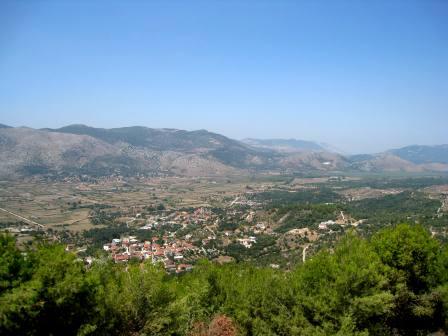
margariti village caption
The traditional village of Margariti in Epirus
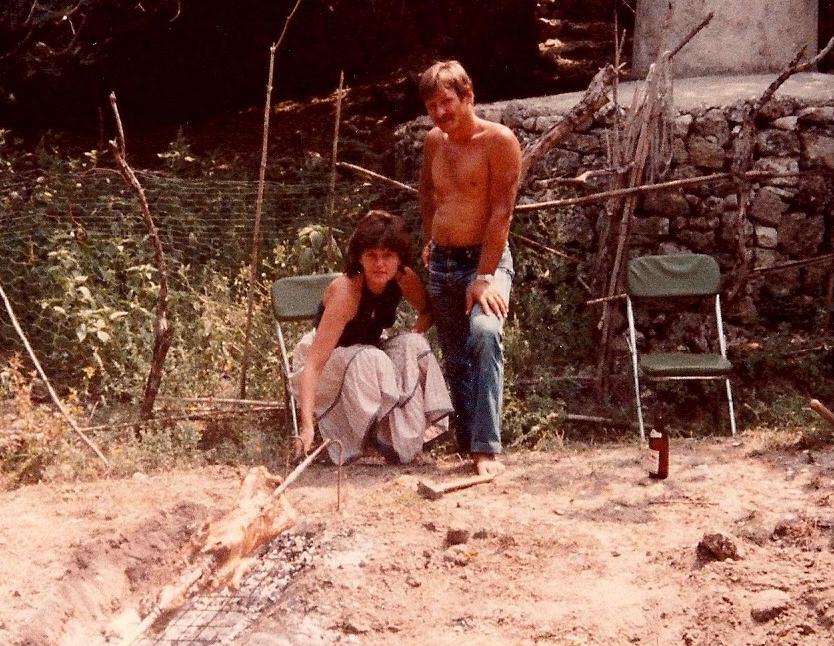
nick and linda cooking goat 1983
A young Linda and Nick in 1983 getting to grips with village life, and roasting a goat for lunch
Q: Later you went to live for a while in your husband’s native village of Margariti, in Epirus, north-west Greece. What was your Big Fat Greek Immersion like?
A: At that age, I had no idea what I was doing. I was madly in love and, probably like every young person then, I wanted a life that was different from the mainstream. Nick was quite a tough person and I realised when I got to his village why he was like that. Most of the people in Margariti are tough. It’s a matter of survival. The journey to his village was my first trip out of the US.  Epirus is a beautiful mountainous area with some of the most exquisite beaches as well like Karovostasi. But lovely surroundings quickly lose their appeal when you’re living in quite primitive conditions, without the ability to communicate with anyone.

Sunday, November 8, 2015

Mourning Trees

How we treat nature, speaks volumes about who we are. When we see the majestic branches of trees that are intertwined with age and wisdom, what do we actually see? Something to: water, climb, hug, prune, or just grab a chainsaw and cut down to nothing?

To some, this beautiful mass of greenery below is a work of art . . .


. . . and yet to others, it's a mess of gnarled obstacles that needs to be eliminated.


That green wall of vegetation stood tall behind our fence one early June morning when I left my house, but it was completely gone in the afternoon when I returned. Beside my own loss, I was struck by the confusion of the wildlife that, for hours and days afterwards, searched for their homes. Birds with worms in their mouths circled the naked area looking for their nests, and squirrels ran about without direction. Their world had vanished without explanation, gone because of one human being, greater than they, who had ownership of, and the means to destroy, a hundred years of growth.

I mourned those trees for a long time after they were gone, each day as I looked out my windows and saw my neighbor's house. Not because of privacy but because I'd watched them grow for almost sixty years. Among their branches were the threads of my childhood, my adolescence, the birth of my children and the struggle of growth that ensued year after year.

I'm really a bit baffled by this new . . . let's call it "change."  Was it my neighbor's desire for clean straight lines and a well organized space? A sort of comment on his frustration at how unpredictable and random nature can be and therefore, a need to tame it in hopes of neat, tightly kept spaces to live life?


For a few weeks I lived in a cave with my shades drawn. It wasn't that people could see in, but rather I couldn't bare to look out. And then slowly I got used to the idea. I accepted the change. The old replaced by the new.

And not long after, there was a similar "change" happening across the ocean, back in Margariti. An old olive tree, unyielding and set in its ways, was cut down and dug out, leaving a tiny orange tree that had struggled beneath its oppressive shadow.

And on the farm, a group of adolescent maple trees was transplanted from where they'd fallen as seeds at the base of a deep ditch.


They were brought up onto flat land, planted side by side within the valley where direct sunlight now hits their branches and the drapery of mountains has become their backdrop for the future, replacing the shady mud of the ditch where they'd struggled to grow for several years. Some are slowly dying and some are fighting to live but it is a certainty that none would have survived much longer in the ditch.


Different location. Different rationale.


I'd love to hear from you!

authorfagiolikatsiotas@gmail.com