Translate

Wednesday, April 30, 2014

Crossing Borders

Ninety dollars. For that amount, we'd be allowed to keep the kids, get back in the car and drive away. But it had to be cash, no checks and no charge cards.
"How do I know these are your children? Do you have their birth certificates?"  The border patrol officer was clearly irritated by something.
"Birth certificates," I thought, "Who goes on a family outing with their kids' birth certificates?" The tears were just below the surface.
"Oh, let them go," the other officer said.
"This is my case!"
And it all started with that one parking ticket in Astoria, Queens.
We'd paid the ticket but there was a $7 surcharge that we didn't know about. Obviously, we wouldn't have paid a $50 ticket and purposely tried to get away without paying that small surcharge.  But that ended up resulting in a warrant for Nick's arrest, which we didn't find out about until he was pulled over by a state trooper for speeding. The officer told us about the warrant and confiscated Nick's license. He questioned us briefly and seemed satisfied with our answers. He was kind enough to allow Nick to remain with us, though I had to promise to do all the driving, which of course, I did.
So we continued to our destination—my brother Bob's house in Henrietta, NY. The next day, I don't remember why we went without my brother and his family, Nick and I decided to take the kids for the one hour drive to Niagara Falls, and we'd heard that the Canadian side was more scenic, so that is where we went. Mind you this the early 1990s and pre-911. The Canadian border was a simple pass-through and we were all still feeling blissfully safe.
On the way back over to the U.S. side, as we approached the border, Nick looked at me and said, "I don't have my green card. I left it at home."  He wasn't a citizen yet.  He just hadn't gotten around to it.  Life kept getting in the way.  But I didn't panic until I realized he had no identification at all. The state trooper had confiscated his driver's license.  
I drove to the end of one of the long lines at the New York border. By the time it was my turn to drive through the patrol area, I was ready to hyperventilate and I felt like my forehead had the word "guilty" written across it.  The officer asked Nick for identification, heard his thick accent and then directed us to park over and go into the immigration office.
They looked up the information Nick provided: how and when he had immigrated and gotten his green card. They saw that his story held up against the records they had. But my tears flooded the room and added to the drama when the one officer declared that she would have to take the children. She seemed satisfied with my reaction and told us that she believed that those were our children but we needed to pay the processing fee of ninety dollars, in cash.  
"Can we write a check?" That was before debit cards and money was not accessible on weekends after the banks closed.
"Cash!"
"How about a credit card?"
"Cash!"
So, Nick counted it out into her palm. No receipt. Just fear. And then we got into the car and high-tailed it.


I'd love to hear from you!    authorfagiolikatsiotas@gmail.com

Friday, April 18, 2014

Missing Person

The last time I saw her, I was seventeen.  It was the summer of 1976.  She had hitchhiked to East Hampton with a spiral notebook tucked under her arm.  Hitchhiking is a risky and dangerous business but she didn't understand that back then.  Everyone was doing it.

When she got to Main Street, she bought a book in a bookstore, walked to the pond in the middle of town, sat under a tree and began to read.  After a little while, she got bored, she pulled out the spiral notebook and began to write.  Her notebook was full.  She was going to be a writer and write for the rest of her life.  But seventeen-year-olds don't know anything.  They think life will stay the same forever. Time is a trusted friend.

I can't tell you what happened after that; I'm really not quite sure.  I heard that she took one ride too many and one of those friendly drivers murdered her, cut her up into small pieces and buried her around in different locations. It must have been true because she disappeared without a trace.

Until the mid 80s.

I saw her briefly, in the woods.  I was sitting on a bus driving from the University parking lot to the
main campus.  It was springtime and I was kind of daydreaming out the window as the bus passed a lovely patch of daffodils that surrounded a sculpture of a swing, the chains and the seat somehow suspended in air as if someone had just jumped off of it.  "How creative," I'd thought. And FLASH! There she was, in the woods behind the sculpture.

It was her.  I'm sure of it.  But how could it be?  She was supposed to be dead.  People don't rise from the dead like that.  It made no sense!

I thought I saw her a few more time, after that. I'd be walking along, engrossed in my own thoughts and then I'd see her, just the slightest glimpse of her, or so I thought.  I called out to her a few times but she never responded. It was kind of embarrassing.  Maybe it was someone who looked like her.  And then just like that, she was gone again and I didn't think of her for many years.

But then, without warning,  she visited me last summer.  There she was, alive and well!  It was right after my mother-in-law passed away.  I was sitting on the balcony, writing.  I glanced over at the balcony door and there she was--looking right at me!  We could see each other clearly.  I embraced her and told her how glad I was to see her back again.  It's a wonderful feeling to reunite with someone you love after having been separated for so long.  I'll never let her go.

Tuesday, April 1, 2014

The Future is in Your Bones


Grandma had a way of saying certain things that made you stop and furrow your brow for a second or two.  Like whenever she saw a black crow she'd say, "Well--someone's going to die." Which of course, someone always did .  .  .  because that's how life goes. Especially at her age.
Grandma: Anne Delisle
She also knew when it was going to rain. She felt it in her bones.  Her weather predictions were more often correct than were those of the local weather reporter. But the idea of predictions based on bones is not such a new concept and I know you're thinking you've heard that one before.


But here's one I'm betting you've never heard. Your future can be predicted in the bones of the meat you just ate.

Sorry vegetarians--no predictions for you.

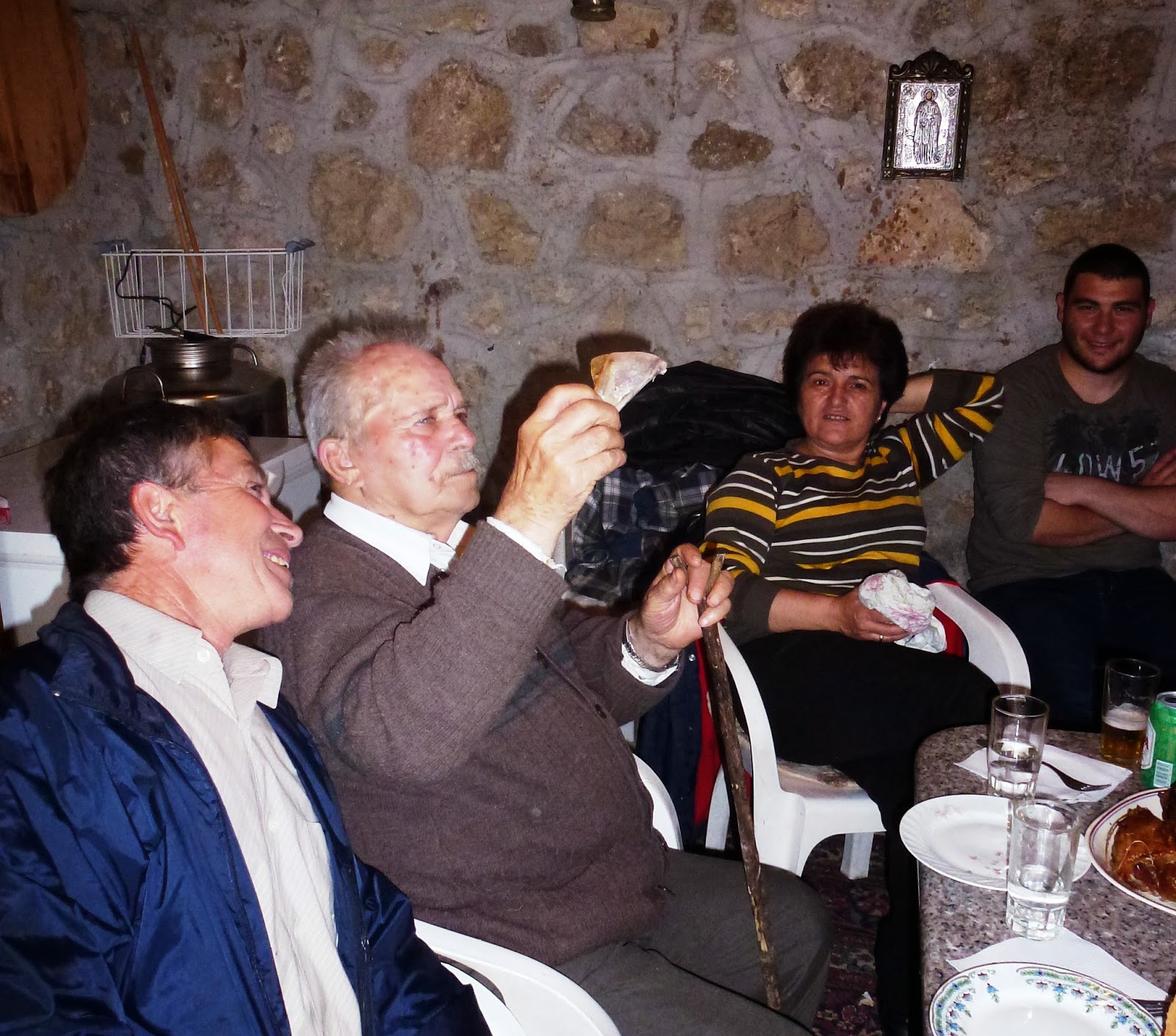
That's my brother-in-law, Alex, to the right. He's the cook, self-appointed because he loves food as much as I do and he's able to take that grass-fed, free-range, organic goat and make it tasty. But more importantly, as the cook, he is responsible for getting that meat so it easily falls from the bone.

And in that bone lies one's future.


So, first the meat needs to be completely scraped off.


Then the reading can take place.


My father-in-law, Toma, is an expert at reading bones.  At least that's what he claims.

His sight is not the greatest.  But don't worry.


By holding it up to the light, all is clear.


Personally, I prefer cafetzu. Reading one's future in coffee grounds is more reliable.


I'd love to hear from you!  authorfagiolikatsiotas@gmail.com

Thursday, March 20, 2014

Do we Really Want the Truth?


I've heard how fishermen might exaggerate a bit when describing the size of the fish that got away, but there's another little fisherman-fib that is not so widely known.

When Nick was a young man in Athens he was paid by the owner of a local restaurant to go out before dawn in a little fishing boat with all the nets and rods--the trappings of a true fisherman. But he was also given frozen fish and instructed to take them out to sea, far from shore. Then he was to defrost them in the water, and bring them back--but to time it so that he was returning to the shore just after sunrise. So he would sail into harbor, with the seabirds circling overhead and the fish lying on the boat floor. And even the locals were fooled by this clever trick, not knowing that the fresh-catch-of-the-day meant freshly defrosted. He was often offered top dollar for them. But Nick had his instructions and he acted accordingly.

"No! Absolutely not," he'd say, loud enough for all to hear. "This is for So-and-so's restaurant!" which was a restaurant that would be packed with patrons because everyone knew the proprietor had his own fishing boat that went out every morning. For Nick, it was a great gig until he was called to duty during the occupation of Cyprus in 1974 and had to leave.

When I heard this story I thought that it must be an isolated case. It was back in the 1970s and it couldn't still be happening.

That was until I saw the T.V. show called Anthony Bourdain: Parts Unknown. You may have heard of it.  He travels to different areas of the world and talks about that area's cuisine.

This particular show was about Sicily--which is really Greece but they just don't know it--and Anthony Bourdain had gone with a restaurant owner/fisherman out to sea to catch the fish for that man's restaurant. Sounds nice, right?  I was thinking, "Mmm. I'd like to eat at that restaurant." But then we, the viewers, see someone with boxes of frozen seafood. And that person is lowering those items into the water after having defrosted them. Then, a few feet away, the fisherman scoops up the lifeless creatures into his boat and bringing them back to shore.

Anthony Boudain expresses his horror and afterwards sadness at knowing the reality of the fresh fish he'd been eating. Here's the clip if you want to watch--> It's called "The Dead Sea."

I have to say, I agree with Anthony Bourdain. This is something I think I'd rather not have known.  And now you know.


"Sometimes people don't want to hear the truth because they don't want their illusions destroyed."


― Friedrich Nietzsche


I'd love to hear from you!   authorfagiolikatsiotas@gmail.com


Thursday, February 27, 2014

Victim or Victor?

I'm not a religious person but I know a good message when I hear it.  That message was delivered years ago by Father John Kefalas while I sat in church during one of his sermons that he was kind enough to do in both Greek and English, at a time when the English-speakers were but a handful in that community.  The message was clear: "Are you a victim or a victor?"

He was pointing to the depictions of Christ's crucifixion and resurrection on the church walls of

 St. John's Greek Orthodox Church

So I'd sit there on Sundays, in that church, looking at my watch, waiting for Sunday School to finish so I could take my children to our customary breakfast at Airport Diner -- a reward for sitting through what felt like a necessary monotony, before I dropped them with my parents and then ran off to work. Nick, having started his workday at five that morning, would collect them when he got home in the evening.

And I was sitting there in the pew, mapping out plans for term papers due and laundry that sat dirty on bedroom floors, of children's homework that needed monitoring and naughty behavior that needed addressing and the thoughts swam together in my brain among so many other worries as the choir sang  and the chanter chanted and the fragrant incense wafted through the air.

But somehow those words leaked through and the fatigue and the fear that I was feeling at not being able to finish the monumental tasks I had begun, began to melt and I heard it: "You are a victor, not a victim!"  Were those his actual words?  Maybe not, but that is the memory I have of that Sunday morning and the message that I would see on subsequent visits to the church with that visual reminder--Christ depicted on each side of the altar: one in defeat on the cross and one of empowerment in the resurrection.

That phrase--You are a victor, not a victim--has become my mantra and has gotten me through many a challenging time. It was a gift from Father John and I lay it out here for whomever feels the need to share it.

We were fortunate to have Father John perform my daughter, Nikki's, wedding five months before he passed away in April of 2012 at the young age of 68.


I'm pretty sure he had NO idea of the influence he had on me.

That being said, look around you.


Who are you influencing?


I'd love to hear from you! authorfagiolikatsiotas@gmail.com

Friday, February 14, 2014

Something Sweet


How about some all natural, organic honey?

In the Greek village of Margariti, Fotis attends to his bees with the love and tenderness of a true beekeeper. The great variety  of flowers only seen on the Epirus countryside is the primary reason for our golden-colored honey with its unforgettable delicate sweetness. The hives line the walls in Fotis' garden and guarantee the pollination of the surrounding fruit trees, which in turn, give us all those yummy nuts and fruits we get to pick in the summer.

Fotis knows, as do all the farmers in Margariti, the importance of bees for sustaining a food supply.  Unfortunately, the bees have had some difficulty in the past years as their populations have dwindled. It seems that corporate farms could use some basic advice . . . perhaps from the Margariti farmers and beekeepers.

Here is a 15 minute video that tells us why the bees have decreased so dramatically in the last several  years. I think it is a worthwhile 15 minutes.  


Monday, February 3, 2014

A Hidden Gem

Alonaki Beach:

There are so many beautiful beaches hidden between the mountains and cut within the rocky cliffs of the Epirus coastline along the Ionian Sea.  Before we had a car in Greece, we were limited to those we could get to by bus.  But once we were able to drive around and discover some of these hidden beauties, we found places where we would be the only two people on the beach for hours at a time.  Granted we had to hike down mountains after having parked the car on the road above, but it was well worth it.

The problem was that we were very ordinary Epirotians, so like us, most people returning to that area for summer vacation were beginning to bring cars and, like us, they were looking for those hidden undiscovered beaches.  But we were still able to find some beautiful secluded places, those areas only the locals knew about.  Or places so difficult to bring electricity and water to, no one had built it up with cafes and hotels yet.

Alonaki Beach is still like that.  It's well known and it can get crowded at times but it seems to be one of those areas that may not have access to water and electricity for a long time -- if ever.  What I love most about it besides the spectacular view and geographical formations that make snorkeling really fantastic, besides the warm water temperatures and the giant boulder to swim out to and jump off of,  besides the protective alcove shape that keeps it as calm as glass, I love the little cafe that someone set up.  It reminds me of the old days before the onslaught of tourists. Here is a little video to show you what I mean.  Look at the steps and the railings.  (My apologies for the quality of the video.  It was made before I learned to hold my phone horizontally for videos.)

The proprietor sells coffee, ouzo and soft drinks from a small trailer (the size of an ice cream or hot dog truck in the U.S.) and his "cafe" area is made up of 3-4 tables with the surroundings created from the nature found there.  Look at the palm leaf "umbrellas."


If you're unable to get there just yet, here is the next best thing!  

Friday, January 31, 2014

Marriage and Family: a Hauppauge High School Course!

Yes, the name of a half-year course, taught by Mr. Gough, that I took as a senior back in 1976 was: Marriage and Family.

These two pictures were taken from the yearbook.  Don't be fooled by the quality of the photos.  The art of photography was not as backwards as it looks. It's just that our graduating class felt that it would be more earth-friendly to have our yearbook on recycled paper.  We knew that society was changing and soon we'd be living in an environmentally sound world.  

I remember the Marriage and Family Class because it was so popular and because it was the only class that I felt would be remotely useful for the life my parents had prepped me for --a life that I was enthusiastically looking forward to.

Specifically, I remember the list of "don'ts" which, if followed, would increase your chance for a happy marriage:


RULE #1: Don't marry someone who is not of the same ethnicity as you are. My Irish boyfriend was in that class with me. I looked at him, batted my eyes and thought, "Well, I guess I could overlook that teeny-weeny little discrepancy."

He broke up with me a month after graduation and shortly after, married Maureen Tipperary.

But my Italian father had always told me the same thing--marry an Italianmarry your own kind--so I guess I thought there was some merit in it. I even remember assessing the boys in kindergarten and then coming home and reporting to him that I was going to marry Michael Savintelloni, at which he gave me his approval. Though it would take me a little longer before I would realize dad's hypocrisy.

"Hey! Wait a minute. Mom's not Italian." But he stuck to his position.

RULE #2:  Don't marry outside of your religion. According to Mr Gough, who was also heavily involved in the local Catholic church, this rule was a deal breaker. You really needed to be of the same faith or you would have all sorts of problems.This idea was reiterated years later by Father Donovan when I brought my Greek Orthodox boyfriend to meet him and talk about a possible wedding at St.Thomas More. His exact words: "You should not marry him."

Rule #3: Don't marry someone who had grown up in a country other than yours.  That person won't understand you because he/she will have different customs and raising your children will be confusing. That rule seemed like it would be the easiest to follow because at that time, the furthest I'd ever travelled was New York City--one trip with my English class to see Equus -- a play about something completely incomprehensible to my seventeen-year-old eyes and mostly forgotten. What I do remember was the full frontal nude scenes and the absolute silence of the audience. 

Mr Gough had a few other rules and these rules were probably based on someone's sound research, but I only remember the three outlined above.They stuck in my head over the years as I awaited the doom that would follow, having broken them all on one sunny February afternoon in 1982, standing in front of a Justice of the Peace at the Suffolk County court house.


Independent authors, such as Ms. Fagioli-Katsiotas often have quite a challenge in getting exposure for their work. I hope, dear reader, you will consider writing a review on Amazon or Goodreads.com.

Friday, January 24, 2014

Cyprus goes to Epirus, Greece


"Not this one!"  she said, shaking her finger at all of them for emphasis, "don't bother this one."
"Just introduce me," Nick spoke up, "come on."
"No way! Stay away from her."
They were speaking Greek so I didn't know the conversation was about me.

It was Andrea talking to the cooks more than 30 years ago, in the kitchen of a Greek diner in New York. She was from Cyprus and she had been given the job of training me as a waitress--which was no easy task. For the first few days, I thought all the workers there were Italian, until I realized that the cuss words they were spewing during the lunch rush were not the ones I knew, not Italian.

Those people were the first Greeks I'd ever met. So when Andrea spoke to them in their language, I assumed she was also Greek.

We became good friends and I learned that she was Cypriot. She told me how she had come to the U.S. at seventeen, leaving her small village for the first time, having gotten engaged to the tall Cypriot man who lived in New York, and then married, but he returned to the U.S. without her, awaiting the immigration papers. She told me how she came to join him and the numbing panic she felt, her first time on a plane, not knowing the language, worried that her new husband would not be there. How she had vomited on herself and the man in the seat next to her and his kindness, helping her, not humiliating her. And the joy she felt when she saw her new husband's face waiting in the crowd of people as the double doors at JFK airport opened and she was -- in America.

She told me about the war between Tukey and Cyprus that started a few months after she had arrived and she stayed glued to the T.V. looking for news about her family, her village but there was no news, only the information in the Cypriot-American community about how her village had been taken over and it would be days before she would hear that her family had made it out and years before she would see her village and her home again -- though only as a visitor on the occupied side of Cyprus.  How hard it must have been for her. I had no idea, and yet we were almost the same age.

I looked at Andrea as a young girl looks at an older sister. She taught me how to make spanakopita, and kourabiethis (Christmas cookies). She was a loyal and dedicated wife, a loving and kind mother.  I took my cues from her.  Below is a picture of her holding my son when he was newborn.
One day while we were sitting in the kitchen of the apartment that was attached to my parents' house, my sister Joanne opened the door that connected the two homes and yelled to me, "Linda, is my shirt on the clothes line?" I had done some of her laundry for her.

I was confused by Andrea's wet eyes as I reached out the sliding glass door and pulled Joanne's shirt from the line. It took Andrea a second before she could speak but she finally said, "This is what I want -- to be with my family. You're so lucky."

"I am?" I thought. I was a person who had an apartment in her parents' home, which is not much to be proud of in this American culture. I didn't feel lucky.

Soon after that visit, Andrea persuaded her husband to make the bold move of pulling their daughter from high school and their son from elementary and moving back to Cyprus. She would not be able to go back to her village, but she would move to a city nearby and she would be with some of her seven siblings--and both of her parents. And so, in 1990 she moved back. She was suddenly gone from my life. I missed her, but I got used to it. Life went on and slowly we lost touch.

Recently, we reunited in Margariti, Greece. It was as if we'd never been apart. We had so much fun, laughing and reminiscing. She was the first one to read my book, The Nifi, and she talked about it with such encouragement and enthusiasm.

Like a good big sister.


I'd love to hear from you! authorfagiolikatsiotas@gmail.com


Thursday, January 16, 2014

Ithaka: It's all about the Journey

Life is about the journey, not the destination. Correct? The poem, Ithaka written by Constantine Petrou Cavafy in 1904, speaks to that idea. But it also was a theme in the novel Your Own Kind.

It is 1974. Alexandros is a young man who has left his rural Greek village to come to New York to work in his cousin’s restaurant. The restaurant is in East End, a small seaside village fifty miles from New York City—not exactly what Alexandros had expected when he heard he’d be going to New York. Sarah is from a small town in the mountains of New York State. She has moved to East End to escape the sins of her past. Of course, they fall in love—no surprise to the readers. But a difference in culture and tradition stands in their way, as Alexandros is betrothed to a girl back home and Sarah has a secret that would deter Alexandros regardless of the situation. Add to that, one son of Turkish immigrants—a love-sick adolescent, whose jealousy, thirst for revenge and misinterpretation of events set in motion a series of actions that lead to violence and heartbreak.  Maybe life would be easier if people would just stick with their own kind. But what does that actually mean? This book explores that theory. (From an interview with Janet Emson)

Excerpt:
        Alexandros had been a brooding adolescent when the schoolmaster gave the older students that book of poems as a gift. There were only four of them in his grade--all boys, but he was the one Mr. Thaskalos chided to stop waiting for life to happen. "Look around you Alexandros! This is life. Live it." But at fifteen, Alexandros had thought he knew more. He needed to go somewhere, do something. But what? His restlessness had blinded him. With the other boys, he'd made fun of the poetry book. What were they to do with it? It was no use to them when hunting or herding.
        But the village boredom that inevitably creeps into the young inhabitants of the mountain led him to the book one snowy afternoon and as Alexandros read it, he was surprised to be moved by mere words. He memorized certain poems--Ithaka was the first--appealing to a young boy because it spoke of Odysseus, hero of the Trojan War. He traced over those same words over and over again until he found himself reciting them inside his head while herding the goats or cutting wood. But it was in this place with this American girl, where the message of the poet became as clear as mountain spring water.
        There he was on an island in America, a jetty of sand sticking into the Atlantic Ocean, six thousand miles from home, and he'd found it--the spirit that stirred him--Sarah. The wall between them, the letter from home, his Laistrygonians, his Cyclops, his Poseidon--it was he who set the monster between them. Suddenly the letter lost it's power.


Below is the poem in video form or written form. Enjoy!


Ithaka
As you set out for Ithaka
hope the voyage is a long one,
full of adventure, full of discovery.
Laistrygonians and Cyclops,
angry Poseidon—don’t be afraid of them:
you’ll never find things like that on your way
as long as you keep your thoughts raised high,
as long as a rare excitement
stirs your spirit and your body.
Laistrygonians and Cyclops,
wild Poseidon—you won’t encounter them
unless you bring them along inside your soul,
unless your soul sets them up in front of you.

Hope the voyage is a long one.
May there be many a summer morning when,
with what pleasure, what joy,
you come into harbors seen for the first time;
may you stop at Phoenician trading stations
to buy fine things,
mother of pearl and coral, amber and ebony,
sensual perfume of every kind—
as many sensual perfumes as you can;
and may you visit many Egyptian cities
to gather stores of knowledge from their scholars.

Keep Ithaka always in your mind.
Arriving there is what you are destined for.
But do not hurry the journey at all.
Better if it lasts for years,
so you are old by the time you reach the island,
wealthy with all you have gained on the way,
not expecting Ithaka to make you rich.

Ithaka gave you the marvelous journey.
Without her you would not have set out.
She has nothing left to give you now.

And if you find her poor, Ithaka won’t have fooled you.
Wise as you will have become, so full of experience,
you will have understood by then what these Ithakas mean.
Translated by Edmund Keeley/Philip Sherrard
(C.P. Cavafy, Collected Poems. Translated by Edmund Keeley and Philip Sherrard. Edited by George Savidis. Revised Edition. Princeton University Press, 1992)