Translate

Friday, August 26, 2016

A Bridge Built by Brits

Relationships are directly linked to physical health and psychological well being, sometimes positive, sometimes negative. There's much research to back this up but it's something I've always suspected based on my own experiences.

When I first came to Margariti, I had only my husband, Nick, with whom I could converse. I interacted with others but rarely by choice. And without understanding the language, it was mostly an anxiety filled encounter. The solution seemed to lie within the language. It was the bridge to a fulfilling life, the missing piece in a perfect setting, the holy grail.

If I could just learn Greek . . .

But Nick and I rarely stayed more than two months at a time. We would return to the U.S., to life, which does not often give you the chance to do what you want, when there's so much that's needed to be done. But I kept trying with Greek language books, with satellite Greek television, and then computer programs when they came into existence. And each of these got me just a tiny bit closer, but still there remained a large gaping canyon between me and relationships of substance. Eventually I acquired a survival-type Greek and with it Greek-speakers often assumed that I knew more than I was revealing. (Something no one ever does, when given the choice of interaction or loneliness.) There were casual friendships that stayed just outside of intimacy, people with whom I wanted to share so much but could only sit on the periphery of their conversations.


And then suddenly, there it was. The beginning construction of a bridge.

Ah, but it wasn't the Greek language that was building it. With one brick at a time, it was the English expats who've made this area near Margariti their permanent home. Slowly the gaping canyon narrowed with the camaraderie of those who understood my plight, people with whom I could discuss an array of topics. Someone other than my own significant other. So bit by bit, as one new relationship after another blossomed, I felt the missing pieces of my Margariti life arrange themselves.

Sunday, August 14, 2016

Greek Math: 1 really equals 2


If you only have a few days to spend in Greece that's okay because one day really equals two. Simply adhere to the Greek spirit of rest and you will be able to double your life span. . . or at least the span of your Greek holiday. . . well, not really. But it will feel like it. And sometimes illusion is better than reality. I'm talking about the Greek custom of the midday siesta.

Take this Facebook exchange as an example of how it works:


Tuesday, August 9, 2016

Don't Kill the Messenger

I've written and deleted this post a hundred times and my indecision stems from two sources. One is sheer ego and the fact that I want everyone to think I am in paradise and they are not. The other is mostly cowardice in that I prefer to avoid controversy and there will be Greeks and non-Greeks who dislike what I am about to say.

Brazil 1960-something
Brazil today
Let me start with Rio de Janeiro because it is a city in the spotlight with the 2016 summer olympics. The sea water there is so polluted that several athletes have left. But it was once a top destination for tourists with some of the most beautiful beaches.

There must have been a time when the tourist business owners began to see the first remnants of foamy film washing up on the shore. Maybe they talked about it in cafes over coffee or mojitos. Maybe it was a moment at which something could have been done but then it was so small and insignificant it was hard to get others to care about it, especially when they were struggling to make a living. How can you worry about a little bit of pollution when you are trying to feed and clothe your children? Besides, the sea is able to cleanse itself. It's done so for millions of years and it will do so again as soon as the tourist season is over.

Beach in Epirus 2016
Greece has some of the most beautiful beaches in the world. Here in Epirus the mountains meet the sea and the water is so crystal clear that you can see the mountainside continue under the turquoise water into the blue-black depths. The water temperature is so comfortable that you can swim for hours without realizing the energy expended or if preferred, float atop the warm blanket of sea and forget every problem that awaits beyond Greece's doors.

A few years ago, a foamy film was occasionally spotted at a few beaches.

Thursday, August 4, 2016

A Difficult Decision

How are decisions made? Maybe you weigh the pros and cons, draw a T-chart, calculate the risks and so forth. Or you just dive in and hope the water is deep enough so as not to crack your skull on the bottom. I don't know the answer to this. I only know that with youth, decisions are made on the basis of an endless future to recover from unforeseen results. But that is no longer an option.

My husband and I raised our two children in an apartment in my parents' house in the U.S. Like every young mother, I did all I could to protect my little ducklings. The kitchen area was built so as to have a window facing the yard in which they played. The yard was strategically fenced to keep them in and to keep danger out. A metal swing set was cemented to the ground in the middle of the yard so that it would be stable as the children played on it. Downy green grass grew beneath it to cushion any falls they might have. And then one day, as I stood at the kitchen window watching them swing high back and forth in the little controlled space beneath the swings, I heard a God-awful crack and before I could get out the back door, a monstrous branch from the neighbor's old oak tree fell square on top of the swing set, engulfing both children and the entire swing set.

I couldn't breathe. "They're dead," I thought just as the leaves parted and both children ran out from underneath the mammoth branch.

Saturday, July 30, 2016

Our Donkey needs a Doctor

Today's cars are yesterday's donkeys. Just look at the width of any village street. No one ever expected anything larger than a donkey and a cart to pass through them.

The donkey was a means for transporting goods as well as people and according to one very well-known Margariti citizen (though it may be only me to whom he is well-known), a donkey elevated one's status in society. And rightfully so. If you had one, you had more freedom than others, a mode of transportation. Thus, it was essential to care for said-mode of freedom.

I've always felt a great sense of camaraderie with the donkey owners of yesteryear when it comes to this idea of autonomy. When my brother-in-law finally traded his motorbike for a car, I sensed a moment of power with the prospect of having a possible escape vehicle, albeit not my own and not one I could drive. I never learned to drive a manual stick shift. But it clearly was a means to escape when escape from the village was necessary. All I needed was a driver.

As I recall, the family donkey was eaten by wolves, a horrible story. He was tied to a tree down on the farm one winter night and when the unlucky family member who was supposed to retrieve him got to the farm, only his half-eaten carcass was left, and of course a frayed rope. Oh the horror! To have lost a loyal and reliable member of the family in such a way but also to have lost so much more.

Supposedly a horse is more valuable than a donkey, however, and it raises one's status to a higher degree than those who own a slow-moving stubborn donkey. So when a horse was purchased from a seller who lived higher up in the mountains, the family was elated at such a lift in status and also enamored by the lovely prospect of traveling at a greater speed while mounted upon a proud stallion. However, no one told them not to let the horse eat too much of the valley vegetation until he got accustomed to the change in diet. The horse gorged himself on valley grass and then died.

Monday, July 25, 2016

Teachers are like Mother Hens?

"You look like a hen with your baby chicks following behind," a fellow teacher once said to me as I passed by her classroom door with several of my students in tow. I liked the comparison. I thought it was cute and also accurate. Until recently.

Here in Margariti, we've acquired several chickens and one rooster. And about a month ago, one of the hens produced a certain squawking sound that my brother-in-law, Fotis, identified as her desire to brood, which means sit on a nest and wait for the eggs to hatch. So, we put fifteen eggs in a well-cushioned nest and Mama Hen sat on the eggs for 21 days. I often emailed photos to one of my sisters who was spending the summer back on Long Island chauffeuring her two teenaged sons around while also jumping through hoops to entertain her six-year-old daughter.

"Twenty-one days until they hatch?" my sister asked. "Tell her to enjoy it while she can."

So, Mama Hen sat in her nest and once in a while I checked in on her, until one day, a few little chirping chicks emerged briefly from under her haunches and then scuttled back underneath. Upon closer examination there were ten unhatched eggs and five open egg shells but only four chicks. The one missing chick was a mystery with a plausible conclusion. A predator most likely ate it. Mama Hen could not leave the nest to fend for one chick when there were so many to protect. I obsessed over that one missing chick for a couple of days and then I just had to accept its unknown fate.

After a few more days, there were more chicks but four unhatched eggs remained. Eventually Mama got off the nest and left those four behind so she could teach the others how to scratch the dirt and find food. At one point a cat got into the area where her chicks were mulling around and Mama ran after him, pecking and squawking until the intruder gave up and left her area, her babies safe, her territory unmarred. But my eyes kept going back to the unhatched four that remained in the nest and the comparison of a teacher and her students was renewed.

"What about the unhatched eggs?" I asked. "Maybe they just needed a little more time."

"Yes, maybe," Fotis agreed, "but then how would she be able to feed and protect the ten who are here now. If she stays on the nest waiting for those four, she'll risk losing the others. She had to make a judgement call."

I nodded. I don't like it. But I understand.


Monday, July 11, 2016

An Apology to the Greek Villagers

I wanted to speak for those who could not speak for themselves. That was the answer to the question asked of me a few years ago back in New York: Why had I become a teacher to immigrant children and then a speech pathologist to brain-injured adults? And as that answer escaped my lips, I realized where that yearning was born. In Margariti, my adopted Greek village. I’ve known that feeling for years. The frustration of wanting to communicate—my way, with my words—instead of through fractured and inadequate translation.

Mary Smith, the author of one of my favorite books, No More Mulberries, said "people thought I was aloof, stuck up . . . If only they understood the agonies of the socially inept." When I read it, I thought, Yes! And then add to that a different culture and different language! That’s the conundrum of being the American-me in Margariti.

The village traditions, celebrations, memorials, festivals . . . are never ending. But my ability to learn Greek is. Or at least it’s petered to a drizzle. The major culprit here is the number of people in any given conversation. In a Greek village, the number is rarely small.

In a group of four, (myself and my husband/translator, Nick, counting as two of that four), I can follow the conversation, though I might ask a question about the foot injury I think you're discussing when you are actually talking about the octopus you caught at the beach. But with such a small group, I feel like I have a fighting chance. And even better if you subtract one person. With three of us, my understanding is a bit clearer and I might venture to add something to the conversation, even if you turn to Nick and say, “Huh? What’s she saying?” I’m no longer silenced by that comment. I still might try to repeat my message without his help. And I can almost understand most of what's being said to me if the speakers don’t have food in their mouths or mumble too much.

Monday, July 4, 2016

A Greek Farming Lesson

Is it healthy clean food you're after? Perhaps you've had the dream I've had since my teen years in the 1970s: to live off the land, pick my own food, simplify life to its basic components.

Well, suffice it to say that my first moments in Epirus Greece in the early 1980s shook some sense into me. Back then I was a new bride, married to a Greek I barely knew and the countryside lifestyle in those days, in that area, was grueling to say the least, but I didn't give up the dream. . . I just modified it. Erase that "simplify life to its basic components" nonsense. I am thrilled with the changes made in Epirus since then: Indoor plumbing, passable roads, independent transportation, a livable house, internet connections. I need a bit more than just basic components, thank you anyway. But the farmer-living-off-the-land dream remained and this year I vowed to make it work. That is, until a few days ago. Now, it appears that I may need to modify a bit more of the plan, based on some recent Greek Farming Lessons.

Here is what Maragariti, my adopted village has taught me:

1. Chicken sh@# is not just a word to describe a fearful person. Chickens actually have excrement and it's disgusting.


2. Picking your own food is a hassle. After it's removed from the ground/tree/bush, it still has to be cleaned and the inedible portions cut off. I now know why Village Greek Salad doesn't consist of lettuce. It's hard to grow and hard to
clean. . . not to mention the fact that I pulled most of it out while I was weeding. It doesn't grow in a neat little round ball. How was I to know?

Thursday, June 30, 2016

Twenty Four Hours in Corfu


The transformation begins on the top step of the airplane stairs. That incredible Greek sunlight carves the Corfu mountains so very precisely into the azure blue sky. It partners with the warm breeze to anesthetize the emerging passengers. And we're finally here, back in Greece! Our fountain of youth. Transformed, we are young, we are strong, we are free!

First stop: Kalami to resurrect an old memory. My first encounter with this quaint little seaside village was in 1990-something when my mother-in-law watched our children and my husband, Nick, and I took to the road in my brother-in-law's tiny car, nicknamed the cockroach (by us only), which now seems terribly ungrateful on our part. I loved Kalami then and the love remains. It's an adorable little bay with a few restaurants and that signature warm blue sea water.

It's also the home of The White House. That's a house-turned-restaurant that was originally Lawrence Durell's residence. He is the brother of Gerald Durell, author of My Family and other Animals which tells of his experience as a child in Corfu in the 1930s. That was an extra treat because I knew it existed but  didn't realize it was in Kalami until we happened upon it. The food was so-so, but the atmosphere for a nerdy bookworm was wonderful as was the scenery.

Next stop: Kassiopi to a hotel that was exactly what a tired stressed-out old lady needed. It was the product of an online search and it was very good luck. Chrismos Hotel was a quiet, tucked-away little treasure with a lovely sea view, pool, cafe and bar.

While there, we visited the village of Kassiopi where we sat in a little cafe and had a gargantuan English breakfast. The English breakfast gets an A+. Nick washed his down with a beer which seemed to be the norm. I ordered Greek coffee which was more like warm brown water. The server explained that the British clientele preferred their "greek" coffee that way and then removed it from the bill. Honestly, the view and atmosphere were so pleasant, I would have eaten shredded cardboard with a smile.

Now, how does one write about spending time in Corfu at this particular time without mentioning the stinky garbage piles?

Saturday, June 18, 2016

Education

I wonder if the children of Margariti know what they have, if they know of the fragility of education for those who came generations before. It's
unlikely.

We're all basically the same. It's hard to know what those before us have gone through so that we could live in our comfortable oblivion.

It was this Margariti school that my husband, Nick, attended as a rambunctious and rebellious student who I have no doubt was a challenge to most teachers' patience. In fact, one disturbing incident that was depicted in a past post entitled, Teacher, may have been the catalyst to his disillusionment with education and thus his choice for disruptive school-behavior. But that's a different story.

At the same time that Nick was attending Margariti School, I was across the ocean, a compliant, looking-for-the-teachers'-praise little student. Along with my classmates, we were unquestioningly collecting pennies to donate to an organization that would send food to the post-war hungry children of Europe. We even had black and white photos of their hungry faces hanging in the classroom, which seems odd now. But I remember feeling a great sense of duty as I begged neighbors and relatives for their pennies.

Nick also fondly remembers receiving American cheese when he was in grade school. It was cut into small square blocks and handed out to the students. None of the children had ever seen such cheese before. In the heat, it became a gooey yellow mess. So, under the direction of my future husband, they learned how to launch it from the end of their pencils and have it stick to the classroom ceiling.  He's always been a mechanical sort of guy.

Thursday, June 16, 2016

Ithaka


As you set out for Ithaka, hope the journey is a long one.

That's the first line from the Greek poet, C.P. Cavafy's poem entitled Ithaka. It has been quoted, translated, and often referred to in its carpe diem, live-for-today theme. But it's such a difficult idea when we are human--to live in the now, to see and feel what is before us at one particular moment or another rather than to rush our lives away waiting for one event and planning for the next.

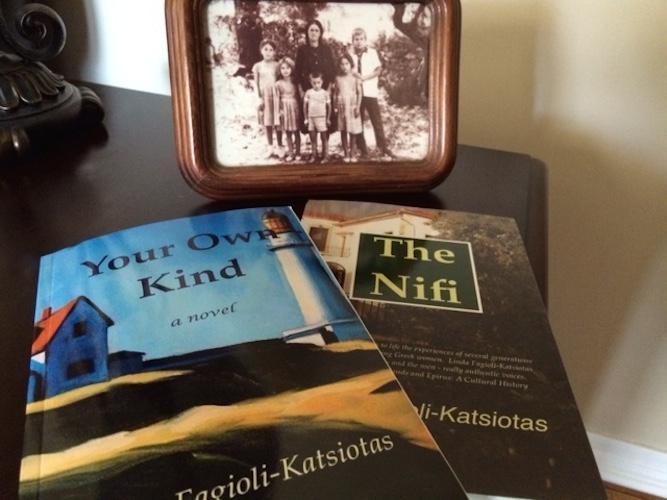
Following, is a link in which Sean Connery, with his soothing voice, narrates the poem:  Ithaka.  And below is a passage from the novel, Your Own Kind, which borrows the idea of the poem.

        Alexandros had read those lines in the tattered poetry book more times than he could count, and yet at that moment, it was as if he were hearing them for the first time. Though the actual words were as familiar as the fingers on his hand, it was here, in the car with Sarah, that the meaning found its real home as the poet reached out through the ages. Suddenly there was an answer to his uncertainty--an answer to the letter his father had yet to send him. 
        Alexandros had been a brooding adolescent in his mountain village when the schoolmaster gave the older students that book of poems as a gift. There were only four students in his grade--all boys, but Alexandros was the one Mr. Thaskalos had chided to stop waiting for life to happen.
        It's a journey and you're on it. Don't wait for a destination; look around you, boy! This is life.
        But at fifteen, Alexandros had thought he knew more than the old schoolmaster. He needed to go somewhere, do something, but what? His restlessness had blinded him. With the other boys, he'd made fun of the poetry book. What were they to do with it? It was of no use to them when hunting or herding. But the village boredom which inevitably creeps into the young inhabitants of the mountains, led him to the book one snowy afternoon and as Alexandros read, he was surprised to be moved by mere words. He memorized certain poems--Ithaca was the first, appealing to a young boy because it spoke of Odysseus, hero of the Trojan War. He traced over those same words again and again until he found himself reciting them inside his head while herding the goats or cutting wood. But it was in this place, with this American girl, where the message of the poet became as clear as mountain spring water.


Sunday, June 12, 2016

Eating Bugs

In Epirus Greece, there is a small village named Margariti. The love I have for this village, some say, is due to a rigorous long-term brain washing . . . which might be true, but it's a love just the same, a love that took hold slowly and evolved as Margariti evolved.

My first encounter with the village was without a doubt something that did not produce feelings of love or anything close to it. It was 1983. Women were somewhat segregated from men so my actions, such as sitting in a cafe with my husband, were grossly against the societal norm.

Nick was the first person who'd ever married a foreigner. And people came from great distances to see the American. I'm pretty sure they were disappointed. Their ideas of Americans came from movies and newspapers. American women were blond and busty like Marilyn Monroe, not dark-haired and flat-chested.

In the memoir The Nifi, I sit quietly next to Nick during each of the many visits as villagers come to greet him after his long absence from Greece and to get a glimpse of his American nifi.

Below is an excerpt:

        As time crept forward and the villagers came to get a look at the American, I did my best to sit, smile, nod and listen to the buzz of incomprehensible conversation. When I would say anything to Nick, all movement would stop as the ever-captive audience would become entranced in the gibberish between us. So, naturally, when a bug was trapped within one of my muffled yawns and I felt it flit about my palate, given the choice of a hacking spit with no hope of explaining my behavior or an unnoticed swallow, I chose the latter. It just seemed more tolerable to me. 
        "I want to go home!" Tears streamed down my face. I tried to sob as quietly as possible, enclosed in the small room, Nick's sisters on the other side of the door. We'd been there less than a week. 


Friday, June 3, 2016

Ouzo, not Orzo

Ouzo, the anise-flavored liquor, and Orzo, the rice-shaped pasta, are quite different regardless of their similar spelling. So, it's understandable that confusion was the main dinner guest one recent evening
at our home. I had been asked, through smartphone text, by a very accommodating cook what I would like for dinner that night. In my Friday fatigue, I elicited Siri's voice command on my smartphone to deliver the message: "I'd love to sit in the backyard and just have a bit of ouzo, maybe with some cheese and olives."

It had been a difficult week and I was reminiscing about the soothing Greek evenings of the past. One in particular at a quaint little ouzeri in the city of Thessaloniki where we'd sat just outside the little cafe, our table positioned at the end of the open wall so a warm breeze blew over us as we watched the comings and goings of the sidewalk as well as the array of characters inside the tavern. We'd quietly sipped our ouzo and discussing the beauty of life as we noshed on an array of mezedes (appetizers). 


Another ouzo-related memory elicited a deep sigh just before my Siri-produced text requesting the ouzo and some hors d'oeuvres. It was that of the sunset at Plataria, a village slightly north of Margariti, our table and bare feet at the water's edge as the server brought us our elixir and some small morsels to snack on.

Both memories are very soothing and among so many others similar in nature. 

Now to be honest, I never use Siri, so she hadn't a number of times to analyze my voice or my New York accent. Thus, it was ORZO with cheese and olives that was for dinner that evening. Apparently that's how Siri had interpreted my request and I, having carefully checked the spelling and grammar before pushing the send button, had further misread it. Still a delicious dinner and even more so with a glass of OUZO on the side.

The novel, Your Own Kind, has one scene between fictional characters in an Astoria Queens restaurant. It is somewhat similar to my first encounter with ouzo. And if you've ever had it, yourself, you may relate to the scene a bit.  Enjoy!

        After they were ushered to a table, Alexandros spoke to the waiter, making small talk before he ordered two drinks and looked at Sarah.
        "We try ouzo. Is strong but is Greek."
        The waiter said something to Alexandros and they laughed. 
        "He says too strong for woman." Alexandros nodded. "Is true. Too strong for woman and for man." He smiled. "But you try, okay?"
        The waiter was a bald man who looked to be about fiftyish with a belly pushing against a starched white shirt, testing the strength of the two buttons midway from his belt. He disappeared for a few minutes and returned with a small round tray balancing so perfectly on the outstretched fingers of his right hand that it might have been an appendage that had grown from his fingertips. Two glasses with a clear liquid sat on top of the tray's surface. The waiter placed each on the table and stepped back a few paces, curoius to see the outcome of their first sip.
        Alexandros and Sarah took their glasses, oblivious to their waiter who was saying something to another waiter as  he passed. That caused the other waiter to slow his pace as he kept his eye on Sarah. Alexandros and Sarah brought the drinks gently against each other in a toast, as Sarah said, "cheers," at the exact moment Alexandros said, "gia mas--to our health." Neither understood the other's words but both felt the same sensation as the first sip entered their months. Sarah closed her eyes tightly as she received the full impact. 
        The air around her had been sweet and warm, the background chatter adding to the warmth but as that first sip passed between her lips, that warmth turned to a raging fire, the ouzo searing her tongue and burned its way down her throat sending flames up into her nostrils and out into the restaurant air. 
        Alexandros was laughing as he poured water into her glass, changing the ouzo to a milky liquid and cutting its potency. He wiped away a tear that was rolling down her cheek. 
        "I'm on fire! What are you trying to do, poison me or something?"
        They both laughed so hard, they didn't notice the onlookers from afar. 


Monday, May 9, 2016

Book Early

No, this is not a post about a book entitled, Early, so my bookworm friends can move on. . .

This is about a man and a woman. She is a high-strung, tight-lipped, plan-it-or-we're-screwed kind of girl who said back in November, "Let's look at a map of Corfu Island in Greece and choose destinations and book hotels." He's a devil-may-care, live-life-as-it-is, free-spirited fun guy who said, "Let's not book anything. Let's just go and let the Corfu mood decide where we stay."

The only problem is they're not talking about 1968 Corfu and they're not hippies. Sometimes he forgets how much Greece has changed since the 1960s.

Book early means, if they don't, they'll be sleeping in their car . . . or does it?

So now, with a Google map on the computer screen, a pad of paper and pencil in hand, she reaches for the telephone and he gives her a knowing nod. Maybe a reservation is a good idea. She dials the long distance Corfu number, with no intension of changing their plan to travel around the island and with a bit of his free-spirit guiding her. Maybe a soft pillow and a fully reclined seat is not so uncomfortable.


To be continued . . .
in the summer . . .


Wednesday, May 4, 2016

Communicating by Phone

"If I want you to divorce me, all I have to do is throw your phone away," my husband says, and I respond,  "Divorce? More like murder."

Yes I love my smartphone and maybe I do stare into it a bit more lovingly than into Nick's eyes, but I believe that comes from the early trauma of my years in Margariti, Greece, when I would have cut off my left arm for any working phone line from that isolated village to my family back in New York.

Patience is a virtue. . . good things come to those who wait. . . Those adages may be true in some context, but personally, I want my information now and I want the ability to talk to my love ones immediately within my grasp, whether orally or via text.

I am eternally grateful that the internet has finally come to Margariti.