Translate

Thursday, June 30, 2016

Twenty Four Hours in Corfu


The transformation begins on the top step of the airplane stairs. That incredible Greek sunlight carves the Corfu mountains so very precisely into the azure blue sky. It partners with the warm breeze to anesthetize the emerging passengers. And we're finally here, back in Greece! Our fountain of youth. Transformed, we are young, we are strong, we are free!

First stop: Kalami to resurrect an old memory. My first encounter with this quaint little seaside village was in 1990-something when my mother-in-law watched our children and my husband, Nick, and I took to the road in my brother-in-law's tiny car, nicknamed the cockroach (by us only), which now seems terribly ungrateful on our part. I loved Kalami then and the love remains. It's an adorable little bay with a few restaurants and that signature warm blue sea water.

It's also the home of The White House. That's a house-turned-restaurant that was originally Lawrence Durell's residence. He is the brother of Gerald Durell, author of My Family and other Animals which tells of his experience as a child in Corfu in the 1930s. That was an extra treat because I knew it existed but  didn't realize it was in Kalami until we happened upon it. The food was so-so, but the atmosphere for a nerdy bookworm was wonderful as was the scenery.

Next stop: Kassiopi to a hotel that was exactly what a tired stressed-out old lady needed. It was the product of an online search and it was very good luck. Chrismos Hotel was a quiet, tucked-away little treasure with a lovely sea view, pool, cafe and bar.

While there, we visited the village of Kassiopi where we sat in a little cafe and had a gargantuan English breakfast. The English breakfast gets an A+. Nick washed his down with a beer which seemed to be the norm. I ordered Greek coffee which was more like warm brown water. The server explained that the British clientele preferred their "greek" coffee that way and then removed it from the bill. Honestly, the view and atmosphere were so pleasant, I would have eaten shredded cardboard with a smile.

Now, how does one write about spending time in Corfu at this particular time without mentioning the stinky garbage piles?

Saturday, June 18, 2016

Education

I wonder if the children of Margariti know what they have, if they know of the fragility of education for those who came generations before. It's
unlikely.

We're all basically the same. It's hard to know what those before us have gone through so that we could live in our comfortable oblivion.

It was this Margariti school that my husband, Nick, attended as a rambunctious and rebellious student who I have no doubt was a challenge to most teachers' patience. In fact, one disturbing incident that was depicted in a past post entitled, Teacher, may have been the catalyst to his disillusionment with education and thus his choice for disruptive school-behavior. But that's a different story.

At the same time that Nick was attending Margariti School, I was across the ocean, a compliant, looking-for-the-teachers'-praise little student. Along with my classmates, we were unquestioningly collecting pennies to donate to an organization that would send food to the post-war hungry children of Europe. We even had black and white photos of their hungry faces hanging in the classroom, which seems odd now. But I remember feeling a great sense of duty as I begged neighbors and relatives for their pennies.

Nick also fondly remembers receiving American cheese when he was in grade school. It was cut into small square blocks and handed out to the students. None of the children had ever seen such cheese before. In the heat, it became a gooey yellow mess. So, under the direction of my future husband, they learned how to launch it from the end of their pencils and have it stick to the classroom ceiling.  He's always been a mechanical sort of guy.

Thursday, June 16, 2016

Ithaka


As you set out for Ithaka, hope the journey is a long one.

That's the first line from the Greek poet, C.P. Cavafy's poem entitled Ithaka. It has been quoted, translated, and often referred to in its carpe diem, live-for-today theme. But it's such a difficult idea when we are human--to live in the now, to see and feel what is before us at one particular moment or another rather than to rush our lives away waiting for one event and planning for the next.

Following, is a link in which Sean Connery, with his soothing voice, narrates the poem:  Ithaka.  And below is a passage from the novel, Your Own Kind, which borrows the idea of the poem.

        Alexandros had read those lines in the tattered poetry book more times than he could count, and yet at that moment, it was as if he were hearing them for the first time. Though the actual words were as familiar as the fingers on his hand, it was here, in the car with Sarah, that the meaning found its real home as the poet reached out through the ages. Suddenly there was an answer to his uncertainty--an answer to the letter his father had yet to send him. 
        Alexandros had been a brooding adolescent in his mountain village when the schoolmaster gave the older students that book of poems as a gift. There were only four students in his grade--all boys, but Alexandros was the one Mr. Thaskalos had chided to stop waiting for life to happen.
        It's a journey and you're on it. Don't wait for a destination; look around you, boy! This is life.
        But at fifteen, Alexandros had thought he knew more than the old schoolmaster. He needed to go somewhere, do something, but what? His restlessness had blinded him. With the other boys, he'd made fun of the poetry book. What were they to do with it? It was of no use to them when hunting or herding. But the village boredom which inevitably creeps into the young inhabitants of the mountains, led him to the book one snowy afternoon and as Alexandros read, he was surprised to be moved by mere words. He memorized certain poems--Ithaca was the first, appealing to a young boy because it spoke of Odysseus, hero of the Trojan War. He traced over those same words again and again until he found himself reciting them inside his head while herding the goats or cutting wood. But it was in this place, with this American girl, where the message of the poet became as clear as mountain spring water.


Sunday, June 12, 2016

Eating Bugs

In Epirus Greece, there is a small village named Margariti. The love I have for this village, some say, is due to a rigorous long-term brain washing . . . which might be true, but it's a love just the same, a love that took hold slowly and evolved as Margariti evolved.

My first encounter with the village was without a doubt something that did not produce feelings of love or anything close to it. It was 1983. Women were somewhat segregated from men so my actions, such as sitting in a cafe with my husband, were grossly against the societal norm.

Nick was the first person who'd ever married a foreigner. And people came from great distances to see the American. I'm pretty sure they were disappointed. Their ideas of Americans came from movies and newspapers. American women were blond and busty like Marilyn Monroe, not dark-haired and flat-chested.

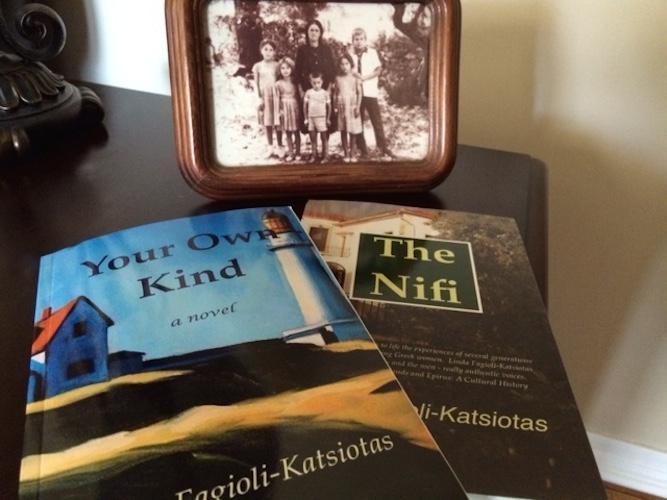
In the memoir The Nifi, I sit quietly next to Nick during each of the many visits as villagers come to greet him after his long absence from Greece and to get a glimpse of his American nifi.

Below is an excerpt:

        As time crept forward and the villagers came to get a look at the American, I did my best to sit, smile, nod and listen to the buzz of incomprehensible conversation. When I would say anything to Nick, all movement would stop as the ever-captive audience would become entranced in the gibberish between us. So, naturally, when a bug was trapped within one of my muffled yawns and I felt it flit about my palate, given the choice of a hacking spit with no hope of explaining my behavior or an unnoticed swallow, I chose the latter. It just seemed more tolerable to me. 
        "I want to go home!" Tears streamed down my face. I tried to sob as quietly as possible, enclosed in the small room, Nick's sisters on the other side of the door. We'd been there less than a week. 


Friday, June 3, 2016

Ouzo, not Orzo

Ouzo, the anise-flavored liquor, and Orzo, the rice-shaped pasta, are quite different regardless of their similar spelling. So, it's understandable that confusion was the main dinner guest one recent evening
at our home. I had been asked, through smartphone text, by a very accommodating cook what I would like for dinner that night. In my Friday fatigue, I elicited Siri's voice command on my smartphone to deliver the message: "I'd love to sit in the backyard and just have a bit of ouzo, maybe with some cheese and olives."

It had been a difficult week and I was reminiscing about the soothing Greek evenings of the past. One in particular at a quaint little ouzeri in the city of Thessaloniki where we'd sat just outside the little cafe, our table positioned at the end of the open wall so a warm breeze blew over us as we watched the comings and goings of the sidewalk as well as the array of characters inside the tavern. We'd quietly sipped our ouzo and discussing the beauty of life as we noshed on an array of mezedes (appetizers). 


Another ouzo-related memory elicited a deep sigh just before my Siri-produced text requesting the ouzo and some hors d'oeuvres. It was that of the sunset at Plataria, a village slightly north of Margariti, our table and bare feet at the water's edge as the server brought us our elixir and some small morsels to snack on.

Both memories are very soothing and among so many others similar in nature. 

Now to be honest, I never use Siri, so she hadn't a number of times to analyze my voice or my New York accent. Thus, it was ORZO with cheese and olives that was for dinner that evening. Apparently that's how Siri had interpreted my request and I, having carefully checked the spelling and grammar before pushing the send button, had further misread it. Still a delicious dinner and even more so with a glass of OUZO on the side.

The novel, Your Own Kind, has one scene between fictional characters in an Astoria Queens restaurant. It is somewhat similar to my first encounter with ouzo. And if you've ever had it, yourself, you may relate to the scene a bit.  Enjoy!

        After they were ushered to a table, Alexandros spoke to the waiter, making small talk before he ordered two drinks and looked at Sarah.
        "We try ouzo. Is strong but is Greek."
        The waiter said something to Alexandros and they laughed. 
        "He says too strong for woman." Alexandros nodded. "Is true. Too strong for woman and for man." He smiled. "But you try, okay?"
        The waiter was a bald man who looked to be about fiftyish with a belly pushing against a starched white shirt, testing the strength of the two buttons midway from his belt. He disappeared for a few minutes and returned with a small round tray balancing so perfectly on the outstretched fingers of his right hand that it might have been an appendage that had grown from his fingertips. Two glasses with a clear liquid sat on top of the tray's surface. The waiter placed each on the table and stepped back a few paces, curoius to see the outcome of their first sip.
        Alexandros and Sarah took their glasses, oblivious to their waiter who was saying something to another waiter as  he passed. That caused the other waiter to slow his pace as he kept his eye on Sarah. Alexandros and Sarah brought the drinks gently against each other in a toast, as Sarah said, "cheers," at the exact moment Alexandros said, "gia mas--to our health." Neither understood the other's words but both felt the same sensation as the first sip entered their months. Sarah closed her eyes tightly as she received the full impact. 
        The air around her had been sweet and warm, the background chatter adding to the warmth but as that first sip passed between her lips, that warmth turned to a raging fire, the ouzo searing her tongue and burned its way down her throat sending flames up into her nostrils and out into the restaurant air. 
        Alexandros was laughing as he poured water into her glass, changing the ouzo to a milky liquid and cutting its potency. He wiped away a tear that was rolling down her cheek. 
        "I'm on fire! What are you trying to do, poison me or something?"
        They both laughed so hard, they didn't notice the onlookers from afar. 


Monday, May 9, 2016

Book Early

No, this is not a post about a book entitled, Early, so my bookworm friends can move on. . .

This is about a man and a woman. She is a high-strung, tight-lipped, plan-it-or-we're-screwed kind of girl who said back in November, "Let's look at a map of Corfu Island in Greece and choose destinations and book hotels." He's a devil-may-care, live-life-as-it-is, free-spirited fun guy who said, "Let's not book anything. Let's just go and let the Corfu mood decide where we stay."

The only problem is they're not talking about 1968 Corfu and they're not hippies. Sometimes he forgets how much Greece has changed since the 1960s.

Book early means, if they don't, they'll be sleeping in their car . . . or does it?

So now, with a Google map on the computer screen, a pad of paper and pencil in hand, she reaches for the telephone and he gives her a knowing nod. Maybe a reservation is a good idea. She dials the long distance Corfu number, with no intension of changing their plan to travel around the island and with a bit of his free-spirit guiding her. Maybe a soft pillow and a fully reclined seat is not so uncomfortable.


To be continued . . .
in the summer . . .


Wednesday, May 4, 2016

Communicating by Phone

"If I want you to divorce me, all I have to do is throw your phone away," my husband says, and I respond,  "Divorce? More like murder."

Yes I love my smartphone and maybe I do stare into it a bit more lovingly than into Nick's eyes, but I believe that comes from the early trauma of my years in Margariti, Greece, when I would have cut off my left arm for any working phone line from that isolated village to my family back in New York.

Patience is a virtue. . . good things come to those who wait. . . Those adages may be true in some context, but personally, I want my information now and I want the ability to talk to my love ones immediately within my grasp, whether orally or via text.

I am eternally grateful that the internet has finally come to Margariti.

Sunday, April 3, 2016

Love and Perception

I recently re-watched the movie, Shirley Valentine and laughed as hard as if it were the first time. The 40-something-year-old British housewife gets fed up with her life and takes a holiday on an island in Greece with a friend. She meets a Greek cafe owner who is in the habit of. . . let's say, romantically-enhancing the holiday of women tourists. It reminds me of the tourist village of Parga, in Epirus Greece.

Years ago, while I was visiting my husband, Nick's, village with the kids and he'd had to stay behind in the U.S., I often spent the day in Parga. It was a short bus ride and a world apart from the little mountain village. The local-male-Greek & female-tourist connection was alive and well, back then. Maybe it still is and I'm just too old to know about it--kind of the same way I think that people don't go out to clubs anymore. But anyway, back then, I was privy to a few awkward attempts by the local males. I watched with intrigue as they tried to communicate with some of the tourists. And I also had one opportunity to practice my newly acquired and very inadequate Greek:  "Don't you see she wears a ring? She's married! Shame on you!" I think that's what I'd said. It's hard to know. The expression on his face could have been interpreted in many ways.

Nowadays Parga is much bigger and more of  a bustling tourist destination. Occasionally Nick and I witness a few female travelers looking for local Greek men and vice versa.

We recently sat in a cafe and watched the carefully executed dance unfold. Our ability to understand the broken English, made it as comical as the scenes in Shirley Valentine.

But back in the late 1960s when Parga was barely known to outsiders, and Nick was a budding adolescent, there existed this---let's call it culture of hospitality. Nick sometimes tells a story about the first American girls he ever met. They were in Parga and he was hanging out with his friends, spending days with those young women on the beach and evenings with them in discos. One of his friends served as the translator.

Author Interview by Janet Emson


It was an honor to be featured on Janet Emson's renown book blog, From First Page To Last. A copy of the interview is below but the blog itself has many author interviews and book reviews for the book lovers among us!

You can check out the blog  HERE

Today I’m pleased to welcome Linda Fagioli-Katsiotas author of The Nifi, a memoir which inspired Linda’s blog and Your Own Kind, a fiction novel. Linda kindly answered a few of my questions.
1. Tell us a little about Your Own Kind.
It is 1974. Alexandros is a young man who has left his rural Greek village to come to New York to work in his cousin’s restaurant. The restaurant is in East End, a small seaside village fifty miles from New York City—not exactly what Alexandros had expected when he heard he’d be going to New York. Sarah is from a small town in the mountains of New York State. She has moved to East End to escape the sins of her past. Of course, they fall in love—no surprise to the readers. But a difference in culture and tradition stands in their way, as Alexandros is betrothed to a girl back home and Sarah has a secret that would deter Alexandros regardless of the situation. Add to that, one son of Turkish immigrants—a love-sick adolescent, whose jealousy, thirst for revenge and misinterpretation of events set in motion a series of actions that lead to violence and heartbreak.  Maybe life would be easier if people would just stick with their own kind. But what does that actually mean? This book explores that theory.
2. What inspired the book?
I married my Greek immigrant husband in the early 1980s. We eloped because it was frowned upon on both sides of the family, regardless of the fact that we were so in love and so compatible.

Saturday, April 2, 2016

Learning to Speak Greek

"I want to ask you a question."

That was the simple message I had intended as I struggled to communicate in my newly-learned-broken Greek, with my brother-in-law. I was alone with my children in Greece--and by alone, I mean without any English-speakers. I knew by his facial expression, that whatever it was I had said to him, was not what I had intended. I waited patiently for my husband to arrive a month later so he could translate. I found out that I had actually told my brother-in-law I wanted to make love. The two words are similar.

By the same token, a few years later, my brother-in-law struggled to use the English he had learned. I was holding his infant son and my guess is that he wanted to say, "the baby loves you." What he actually said was, "I love you, baby."

Language is so integral to who we are and when one is surrounded by the incomprehensibility of an unknown language it can be a very frustrating situation.

My attempts at learning the Greek language have been many, the first of which was back in the early 1980s after having fallen in love with my husband, Nick, who was a Greek immigrant in the kitchen of a diner. At the time, I was enrolled in a college computer class trying to learn the language of computers which turned out to be far more illusive than the Greek language--for me, anyway. Rather than attending to the nuances of Cobalt Computer language, I sat in class writing and rewriting the Greek alphabet. Now, if my handsome Greek cook had spoken Cobalt, I might have become a computer programmer, but alas, that whole college stint didn't work out very well, but that's a different story entirely.

Fast forward to the newlywed couple about to embark on a trip to Nick's village of Margariti, in rural Epirus Greece, 1983. I'd bought a book in Queens, New York called Greek Made Easy. Even as I write this, the title makes me laugh. I'd studied it faithfully, hours a day, to prepare for my trip but once there, no one understood a word I was saying, or trying to say. A book entitled, Greek Village Language would have been much more useful.

Fast forward another ten years as I acquire my position in the local school district, teaching children who do not speak English. It's a very rewarding and sometimes comical job. Some examples of the questions students have asked me are:

1. Why do people always say "cheeses" when they are upset? The student was actually trying to interpret the exclamation "Jesus!"

2. What does "speechy" mean? This one was a little harder for me. I asked the student in what context he'd heard it. His answer: "I said to someone, 'how are you?' and she said, 'just speechy.'"  Interpretation: Just  peachy.

Friday, April 1, 2016

A Little Village

My mother is from a place called Malone. It's a small village, or so it seemed to us Long Island kids when we spent summers there, just along the Adirondack Mountains near the Canadian border. To us it was a quaint little place with a main street, fair grounds and a recreational park where a small river was cordoned off for swimming. I remember it fondly, but to mom it was a place from which she needed to escape, so in the early 1950s she made a journey to New York City to live with her sister. That's where she met the I-talian, as Grandpa Omer used to call my dad--the foreigner. Though dad was born in the Bronx, I suppose that was like a foreign country to my Adirondack grandparents. I wonder what Grandpa Omer would have thought of my Greek husband, had he lived long enough to meet him.

My mother's mother, Grandma Anne, came from a tiny speck of a village called Owl's Head. She resented having to keep house after her father died in a logging accident and her mother had to run the general store. She married Grandpa Omer to get away from her little village and to live in a large town like Malone, as she put it.

My Italian grandmother, Nanny Giovanna, and her husband, Chelso who died long before I was born, came from two small villages whose names escape me. Nanny always identified them as being near the Italian city of Piacenza. She came through Ellis Island to the U.S. in the early 1900s, and according to her, the one and only reason she left was so that she wouldn't have to work on the farm. She always said that she never regretted leaving. Village life was just not for her. She met her husband in the Bronx and yes, life there was quite a distance from the family farm on the Italian countryside.

And yet, here I am living my entire life in a never-ending sprawl of suburbia outside of New York City--always longing to be part of a village. The irony is palpable.

The first time I saw my husband's small village of Margariti, in Epirus Greece, if we can ignore the mind-numbing culture shock, I do believe I fell in love at first sight . . . or maybe second.  I was especially  attracted to the closeness of the people and their symbiotic lifestyle.

So maybe my ancestors put forth great effort to remove the little villages from their past, in the belief that they were creating a better life for their descendant in the future. But I'm pretty sure the little-village-gene got passed down and their good intentions were overthrown by nature.

Tuesday, March 22, 2016

Searching for Your Roots

There seems to be a natural pull from the past for people to seek out information about their ancestors. I'd venture to say this is the reason for so many websites: ancestry.com, geneology.com, my heritage.com . . . They go on and on. For us Americans our heritage usually lies in another country, unless of course, you are a descendent of a Native American. This may be the reason I was so attracted to my Greek husband in the first place. His foreign status reminded me of my Italian heritage that had been washed clean in an American suburb. The Greekness was so concrete and defined and familiar . . . but it was his, not mine.

I wanted it.

There's nothing worse than a convert, right? And I think I've proven that. Once I securely harnessed the wild Greek with a marriage license, I dove head first into the Greek culture, dragging my Italian extended family with me. (Nick's family were all in Greece.) And I was so successful that my nephew, Steven, with my Italian brother as his father and a mother who came from the nicest Long Island Brooklyn-Italian stock, came home from kindergarten one day with a heritage project sporting a large Greek flag. My brother, Jim, had a talk with him but I'm not sure Steven accepted it completely. Twenty years later he went to Greece for his honeymoon. . . I'm just sayin'

Cousin Dina, Tom, Nikki and Cousin Marianna
But this seems to be true for others as well. In my visits to Margariti, Greece, I've come across many Brits and Australians looking for evidence of their past. Some are former vacationers who had a memorable summer in their youth with a local Greek while others are themselves Greeks--children or grandchildren looking for evidence of their past. One in particular stands out in my mind. She was a young woman from Australia. She'd come to find her heritage and I was there alone with my kids that year. It was a very difficult situation for us both and when we found each other it was like finding water in a desert.

Sunday, March 6, 2016

The Face of Courage


Chevi & daughter, Anastasia
Imagine you are a young child running for your life, from an enemy of whom you’re certain wants you dead or enslaved. You’re being guided by the one person you trust the most: your mother. And yet at the very moment that you feel freedom is but a breath away, you are sent to your death by that trusted person. 

This is the story of Anastasia Lykas from the villages of Souli, in Epirus Greece. She was my mother-in-law, Chevi’s, great grandmother and her spirit remains in one of Chevi's daughters, a namesake—Anastasia, a woman of strength and determination.


Near the village of Zalongo atop the majestic cliffs that overlook the Preveza Bay and its lush green valley, stands a monument to those brave women who fled their enemy in 1803 during the Souliotes  War. One of them was twelve-year-old Anastasia Lykas. The monument is barely visible from the main road, but it remains an important tribute to the memory of those women, forced to make an unforgivable choice so their children would not experience an even greater horror.


Saturday, March 5, 2016

You're not Greek unless. . .

To be truly Greek is to be baptized in the Greek Orthodox Church. The number of times a person attends church afterwards is not relevant nor is that person's lifestyle. Simply, you must have been baptized in the Orthodox Church to make the claim.

I did not make that plunge until Nick and I were twenty years into our marriage. I had taught Sunday school at the Orthodox Church and dragged my kids every week to those services and to church celebrations while Nick worked. In fact, Nick was there so rarely that at one church-filled Easter service Father John jokingly looked at him standing under a gargantuan chandelier and made a hand movement for him to move aside, first looking up at the light fixture and then at Nick, as if to say, just incase God enjoys irony.


Years before, however, as a young mother, having married outside my own faith and feeling the strain of being an outsider, I agreed to have our children undergo this major Greek blessing.

Nikki was baptized by Father John in St. John's Greek Orthodox Church on Long Island at the oblivious age of six weeks, as was common among my side of the family, the Catholics. However, Thomas was baptized by Father Basil from Senitsa. The ceremony took place in the Margariti church in Greece and at two and a half years old, Thomas was old enough to protest and call out to us while Nikki tried to execute an escape.  

Here is an excerpt from  the memoir, The Nifi:

     I helped Akis gently lift my son from his mangled clothing. Thomas liked his adolescent Godfather very much, as he was someone who always seemed to have time for fun, but that unwelcome new activity was now creating a scowl of distrust on Thomas' face. 
     "No! Go out." His little finger pointed to the church door, but he was quickly whisked away and was being carried up to the caldron of holy water near the altar, his cries escalating.
     "Mommy!"
     I kept one hand on his warm back as I tried to keep pace with the others. 
     "I'm here honey. . . I'm here."
    "Hey, what are you doing to my brother!?" Nikki grabbed at the robes of the priest as he took the screaming little boy in his arms. She was readying to execute some kind of rescue as she pulled back her leg for a kick and I wondered at the wisdom of subjecting small children to such a ritual. 
     The relatives stood about with big smiles, talking and pointing at Nikki as she continued her efforts.


Wednesday, March 2, 2016

A Bed in the Yard

Without a doubt, the weather of Greece invites an outdoor lifestyle and with it comes the need for outdoor furniture. In the U.S. lawn furniture can be as fancy as a cushioned couch or as cheap as a metal put-together-with-spit-and-glue chair. In Epirus, Greece, those white plastic chairs that the gypsies sell off the back of trucks, are most likely what sit on balconies and in yards. However, before the 1990s, an overturned wooden box or the steps of a house, were a perfectly good place to sit.
And for siesta, there was always a bed out in the yard. Every house had one. I remember the peculiarity of it when I first came in 1983. But then those beds faded into the familiar background as the years progressed, until they slowly ceased to exist. This photo shows Cousin Evangelini at her house in 1988 preparing for siesta.

A bed outdoors had the same function as an outdoor lounge chair but really more practical when you think about it because it could be used inside or outside. In those days, there was no money to waste on something that would have a limited function -- like outdoor furniture, at least not until the EU money started to flow. And if one wanted to sit outside, rather than recline, a wooden or metal chair could easily be dragged from the house.

It wasn't until many years later that plactic products emerged with a vengeance. In fact, I helped to increase the barely-existent Epirote global footprint by bring plastic ziploc bags and plastic tupperware containers because I was not satisfied with the cloth that was laid over the food as protection from flies or the leftovers in the refrigerator, uncovered. Alas, I hold my head in shame.

After the two o clock meal, shops closed for the four hour “siesta.” And all movement stopped – even the animals slept. There was neither a bark nor a tweet (only a few light snores emerging from those beds) and it was a silence I've not heard since.  At first, it seemed odd to give so much time to the day for something as useless as sleep, but then as time went on, I could feel my eyelids grow heavy as I ate the afternoon meal and it just seemed natural.


My daughter, Nikki, however, wasn't having it. She never did see the point. On the other hand, Thomas, my son, was a true sleeper so he was completely on board with it all, no matter where we happened to be at the time. I also embraced it, though I usually slept less than an hour. But I would wake up so refreshed and ready to start anew.


There is something about having everyone around you just stop and regenerate. I long for those siestas when I'm away from Margariti. There is wisdom in such a custom.